The Secret Language of Comics

Tracing Pages Reflection


Assignment link here.
Essay link here


Reflection timeeeeee

Thesis: In “Stitches” and “Spinning,” the different uses of gutters and perspectives support each other to show the character development of the main character in the frame while they are in the presence of another character. Both authors use the same technique but in different ways to portray their narratives.

While tracing the panels, I was mainly thinking about art style, and how they drew the panels. I enjoyed doing it because I felt productive but not at the same time. After tracing the pages, I couldn’t find things that I could analyze, but I went back to the chart with all the elements of a comic. Looking at each column, I was able to find at least one thing to annotate or note. I really just had to not overthink it and just *look*. It was fun realizing similarities and differences in between the two pages.

As for the essay style, I was looking forward to writing it. When I write the usual 5 paragraph deductive essays, I find a better way to present the essay near the end after I discussed the thesis. When I write an essay, I have a good grasp about the parts but not how they connect as a whole. Inductive writing would make sense for me because I can really present the main part of the essay after I discuss the evidence. I would need to compare deductive and inductive essays to truly see which one I like better. I also had to limit myself to not reveal the thesis in the early sections because you usually had to connect it back to the thesis while writing about the evidence.

As for the secret language of comics, I think it helps me to watch out for certain elements of the comic and bring it into a boarder context of the story. I only annotated one page per comic, but if I spent time in analyzing more pages, I would be able to get a better grasp of the comics. I learned that I had to compare frames to see certain things like with “Spinning” I didn’t realize the changed background in between panels. I totally overlooked it at first.

Tracing Stitches and Spinning Reflection

The thesis of my paper is that both Tillie Walden and David Small both slow down time and disorient the intended direction of reading to emphasize their respective emotional climaxes. I identified each of these climaxes as David realizing that his mother doesn’t love him, and Tillie underperforming at worlds, which eventually leads to her crashing her car.

Before choosing a page from both Spinning and Stitches, I knew that I wanted the pages to relate somehow. Something that we talked in class about both works was Tillie’s and David’s emotional climaxes. Therefore, I took a page from each comic that I interpreted as each character’s emotional climax. I felt that annotating and tracing the pages was very useful. It was almost like a forced pre-writing assignment since it helped me brainstorm ideas. By analyzing and annotating my tracings, I applied the concepts in Chute’s essays and began to notice the similarities and differences between the works.

The writing of this essay did not change my writing process too much. I still brainstormed ideas before and lightly outlined my essay. If anything, this essay was quicker to write because it is acceptable to immediately to start analyzing the evidence. There is no need to write and wordsmith an introduction.

After doing this assignment, I do feel that I understand “the secret language of comics” better. When initially reading both of these works, I did not notice any of the patterns I discussed in my essay. During my first read of both Stitches and Spinning, I was more reading for plot rather than examining the author’s images intricacies. Tracing and annotating really opened my eyes to how each author poetically elaborated about key plot elements. For instance, by tracing the page in Stitches, I realized that all the panels showed no signs of life, which emphasizes David’s loneliness. In my essay, I make further analysis like this. Therefore, I feel like I do understand Stitches and Spinning more after writing this essay. By tracing and annotating, I know realize why creating a certain page or panel may take weeks for an author to illustrate. In Chute’s essay, Art Spegielman says that he sometimes spends weeks on certain panels in pages. I initially thought that he did to make his art high quality and implement simple illusions. However, after writing this essay, I know realize that authors must draw their images at a high quality, but also they must decide, which poetic patterns they will use to highlight certain messages or plot points.

Prompt

Essay

Tracing Pages Reflection

The thesis of my essay is “The two different uses of slowed progression of time and movement were used to highlight the significance of both scenes.”. My main arguments are that the choice of moment and flow were most influential on the pages I analyzed. The design choices made these pages stand out among others throughout the novels.

I enjoyed the process of tracing and annotating. It was interesting to analyze the pages without text, even though the pages I chose originally didn’t have much dialogue or text. It was useful to go through the five choices in comic making and see if I could see them represented on the page. The suggested themes to consider were also helpful because they helped me categorize my annotations. The whole process helped me delve deeper than surface level observations.

My writing process didn’t completely change with the inductive thinking format. I knew pretty quickly what my first two topic sentences would be. It has always been hard for me to formulate thesis sentences. In this instance, I found it to be more difficult because I would easily slip into thinking that my first topic was my thesis even though it wasn’t. This confused me until I took some time to draw conclusions I made from the points made in the first couple of paragraphs. I was then able to choose which I felt fit the best.

As mentioned before, this project helped me look deeper at the pages. I think I overlooked some concepts when I first read these two novels. Analyzing them allowed me to look really close and try to observe as much as possible. It is easy for me to gloss over pages and not look at deeper meanings. After this process, I realized why that can be dangerous. It can cause me to miss important themes and messages that could possibly change my viewpoint on a character, situation, or topic. For example, I honestly missed the point of the zoomed-in panels in Stitches and the many little panels on the page in Spinning. I have been able to understand the likely motivations behind these design choices. I think I now appreciate the creativity and attention to detail a lot more.

Link to project: https://selazzioui.wordpress.com/tracing-pages/

Link to assignment prompt: https://eng181s21.davidmorgen.org/assignments/tracing-pages/

Tracing Stitches and Spinning Reflection

The thesis of my essay is: having similar flow while describing similar experiences with their crushes, the authors are able to help their readers relate to the comics through their own imagination. Because both authors used similar techniques describing their similar experiences, their comic help the readers relate to the content in a similar way. The readers will either relate to the story through their own experience, or their imagination.

Before writing my essay, I traced the pages of Stitches and Spinning, and annotated them with my own notes. This process helped me understand the panels better since I was essentially the author drawing the comics. I noticed more details about the panels, such as the length of the descriptions and that the panels do not follow an order for the readers to read, which I included in my annotations. Looking at the whole page, I felt like I understood the comic better, and also understood some of the techniques that the authors used to help the readers relate to their comic. This helped the writing process of my essay.

To address the assignment of writing an inductive essay, I did not change my writing process drastically. I was never truly conformed to writing one specific structure of essay, especially during my high school years. My high school teachers never taught me that the five-paragraph essay is the only way to write essays, instead they assigned me similar essays to this inductive essay, and sometimes even allowed me to create my own structure. Therefore, I did not feel clueless when I was assigned an inductive essay. I just learned the structure of the inductive essay and went on with it.

Overall, I think this assignment helped me understand the “secret language of comics” better. I noticed more details in the comics that a normal reader would sometimes glance over, and realized that some of those details are not random but techniques that the author used to help the readers understand and relate to the content. One insight about the two books that I did not notice before it how similar they are. The main characters in the books, who are the authors in reality, describe multiple stories that are very similar to each other in almost the same way. The two pages that I have selected for my essay is only one example, but after trying to find 2 pages from each book, I noticed a significant amount of similarities between the books.

Assignment prompt

Analysis essay

Deductive -> Inductive Writing

I got a couple inquiries asking about how to structure the inductive essay. Here’s a walkthrough of revising a deductive 5-paragraph essay into an inductive 3-part essay. Hopefully this helps!

A number of years ago, I assigned students at a class three hard-boiled detective short stories and assigned them to write a comparative essay in response. Below is a real essay a student wrote in response, which has some good observation in it but the five paragraph structure of the essay seriously undermines the author’s ability to make any kind of argument.

Here’s a reverse outline of that essay:

  • Introduction
  • Description
    • Ways of describing Los Angeles
    • Ways of describing women
    • Ways of describing areas where they are (like specific rooms)
  • Mood
  • Attitudes toward women
  • Conclusion

We know that in the five paragraph essay the introduction and conclusion are redundant and don’t really do anything to move the argument of the essay forward — they are just introducing the topic and repeating that introduction, so you can get rid of those. Then looking at what remains, you might notice that you could easily rearrange these into two topics: ways of describing women and attitudes toward women seem to naturally go together, leaving descriptions of L.A., descriptions of specific locations, and mood (which seems to naturally fit with description of place) together. Let’s lay those out as a thesis and antithesis:

Description

All three detective stories include a lot of description of settings, which sets a particular mood. The detectives are all on the lookout for clues and, even more importantly, they are also very aware of danger in their surroundings. The overwhelming amount of description in these stories helps the readers to be aware of just how observant the detectives are — these are heroic observers who are always on the alert and always in control of their surroundings.

Attitudes toward women

The women in these stories are “damsels in distress,” but they are also seductive, “sneaky,” and manipulative. The detectives cannot say no to these women, so they throw themselves into danger to protect them.

What you’ve got now are a thesis and an antithesis: in all three stories, the detectives are always in control and always on the lookout for danger … until a pretty woman in distress asks for help and then they all turn into blithering idiots who will do whatever they are told without concern for the danger. There are numerous syntheses that one might draw from these two ideas: perhaps you argue that these stories are misogynistic because they show women using sexuality to manipulate and deceive the heroes or you might argue that in these hard-boiled detective stories, that seem to be part of a very male-dominated genre that is all about the heroic exploits of the male protagonists, it’s actually the women who have the most agency and are most responsible for driving forward the plots of the stories.

The first sentence of the essay, which is the introductory sentence of the essay and establishes what texts you are analyzing and also serves as the topic sentence for part one of the essay might be something like: “In The Big Sleep by Raymond Chandler, “Murder is My Business” by Lynette Prucha, and Devil in a Blue Dress by Walter Mosley the narrator provides lots of detailed description throughout the narratives, in order to show that the protagonists, who are all hard-boiled detectives, are very aware of and in control of their surroundings at all times.” The rest of that section would then follow with evidence to expand upon and support that claim.

The first sentence of the second part of the essay, the topic sentence for part two, might be something like this: “However, in all three of these stories the protagonists who had seemed to be so in control of their situations, suddenly become easily manipulated into putting themselves at risk when they come into contact with a ‘damsel in distress.'” The rest of that section would then follow with evidence to expand upon and support that claim.

The first sentence of the final paragraph of the essay, which is the thesis statement for the entire essay, might be something like this: “This contradiction, where the protagonists appear to be alert and in control until a seductive woman asks them for help, shows that in these hard-boiled detective stories, that seem to be part of a very male-dominated genre that is all about the heroic exploits of the male protagonists, it’s actually the women who have the most agency and are most responsible for driving forward the plots of the stories.” The rest of this paragraph would expand on and support that claim.
 

Sketch 6: What’s in your bag?

Contents: A calculator, Macbook Pro, 2 black pens, spiral notebook, computer charger, and a USB-C Iphone charger.

I think this image partially represents me. Currently, I do not have any in person classes and majority of my work is online. I do not need to carry around notebooks or papers for each class because my notes, submissions and readings are all accessible from my computer. At a glance, I would assume this is a minimalist backpack with only essentials. As I grew up, my backpack was always filled with books and was very heavy. I try to pack as lightly as possible now so my backpack does not become a hassle when I am going from place to place. My brother received the backpack from one of his past jobs and gave it to me.

Sunday Sketch 6 – What’s in your bag?

  • Tory Burch Women’s Piper Small Zip Backpack: I bought this backpack just because it was pretty, but now I am regretting it, because it does not have enough storage space.
  • iPad Air & Apple Pencil: I use my iPad instead of notebooks. The notes for every class I take are in my iPad.
  • MacBook Air & Kate Spade Laptop Sleeve: I bought this MacBook in my junior year of high school and it is the most important thing when I study since high school. The laptop sleeve protects my laptop from minor knocks and bumps.
  • Hair Ties: I tie my hair when I study or eat, so I always need to have it with me.
  • Bath & Body Works Hand Sanitizer: To sanitize my hand when I am outside.
  • Tearin Free Eye Drops: When my eyes are dry.
  • Pencil case: I put pencils, pens, highlighters, white-out, and eraser in my pencil case, so I can use them when I need to write something. 
  • AirPods 2 & AirPods Pro: AirPods is needed when I want to listen to music or watch videos. I bring two of them, since I often forget to charge those.
  • Jo Malone Wild Bluebell Perfume: I just love perfume.
  • Casio Scientific Calculator: For my Chemistry class.
  • Sticky Notes: I often forgot what to do, so I write it down on sticky notes and put them on my laptop or the wall.

I feel like this image is very representative of me, because I do not carry anything unnecessary and always want to keep my backpack as light as I can. I tried to organize things in a square shape to make them look neater. I feel like this was the easiest Sunday Sketch that I had, since I only needed to explain what are in my backpack. Representing myself in a catalog of the stuff in my bag is a type of writing, since it reflects who I am as a person.

What’s in my bag?

This image represents me as a person very well. I am a very minimal and concise person and I hate making things more complicated than they actually are. This is shown very well in the image above as all the items in my bag are necessary to me in my every-day life. I do not carry around useless items as they add more weight in my bag, and I try my best to prevent accidents from happening that require additional items that are not always in my bag. The challenging aspect about this assignment is that I do not carry around a backpack with me every day. Most of the time I study in my own room, so there is no purpose packing a bag every morning. Therefore, I thought about what I would bring on a regular college school day, attending all my classes in person. I think representing myself in a catalog of the stuff in my bag can be considered a type of writing, but more towards the visual side. A person can be represented by the items in his/her bag, and the viewer of the image can imagine or assume certain things about the person just by looking at certain items. The process of interpreting the items in someone’s bag is similar to the process of reading a book and interpreting the meaning behind certain plots.

What’s in my bag?

In my bag I have a Surface Pro 7, laptop charger, iPhone charger, sunglasses, regular glasses, a Ti-84 calculator, earbuds, earplugs, pencil case and my key. I try to go paperless, which is why I carry a Surface Pro with me because it doubles as both a tablet and a laptop, and it is light too. However, not everyone is paperless, so I carry a pencil case with me in case I need to write things physically down. Earbuds are essential in our Zoom environment, though I don’t know why I carry earplugs with me… I carry sunglasses, because Atlanta is sunny sometimes, and then I need glasses because I am near sighted in my left eye.

I think the things in my bag represent me because the items are very practical, but also very organized. The laptop has its own case within the bag, the chargers are in a black drawstring bag in the backpack, my earbuds are in their case, my glasses are in their case, and my stationery is in my pencil case. All of these mini-compartments are then housed within the large bag, making it very organized. Even the spacing of the items on my bed is very compartmental.

What’s in my bag?

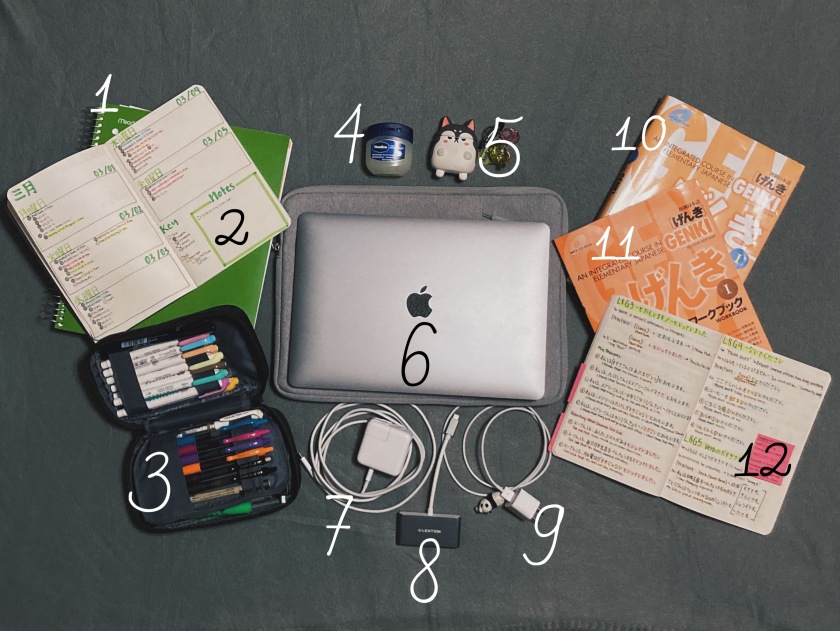
What I carry around with me at home

Since I’m doing classes from home this semester I put away my backpack but this is usually what I have at my desk on a daily basis or when I feel like doing work in the living room, I carry it over with me.

  1. 5-Subject journal: I used this last semester—not much—so I’m continuing to use it this semester to take notes for some of my classes such as psych, anthropology, and some annotations while I read the comics for this class.
  2. Bullet journal (bujo): I started creating my own bujo sophomore year of high school when I found out about them through my friend, and have continued since. Last semester, however, I only made a spread for the first week of school then I felt so unmotivated that I switched to a store-bought planner my sister had gifted me for my birthday earlier in the year, so this journal still had more than enough pages for me to actually use it consistently this semester. Not only does it help me be aware of deadlines and stay on track—in addition to an excel masterlist calendar which isn’t as detailed either way—every week, but it’s also very rewarding for me crossing off completed tasks.
  3. Pencil case: My handy-dandy pencil case which I’ve had since sophomore year of high school—I wanted to feel like my school life was in order sophomore year. In the picture you can only see the “front half” but you can flip over the middle flap to see the “back half”. It holds my pencil, mildliners, gel pens, micron pens, my 2 tombow fudenosuke pens—which are actually dried out, I need to replace them :(—some additional highlighters, markers I use for my bujo’s accent colors, my white-out tape, and some sticky notes.
  4. Vaseline: I suffer from chapped lips all the time and I’d always buy chapsticks—also always lose them—until I read somewhere that chapstick isn’t really as effective as they’re supposed to be. I don’t know if it was chapstick that would just encourage it to be an endless loop of me constantly licking my lips and making them more chapped or if it was just a bad habit of mine sort of thing, but I made the switch to vaseline and it works so much better for me. I bought this mini version from Walmart; there was an even minier and cuter version but this seemed like it would last longer and still be easy to carry. Although it is way bigger than thin little chapsticks, I recently did manage to lose it for a couple of days. Oops.
  5. Airpods: If I’m not in class and not doing homework that requires me to listen to a video or any type of audio, I most likely have my airpods in listening to music.
  6. Laptop: With all my classes being virtual, this is essentially my top priority tool.
  7. Laptop charger: Can’t be letting my laptop die on me while I’m in class—it’s only happened once—or while I’m doing homework.
  8. 4-in-1 USB-C Hub: I use this adapter for multiple reasons; when I want to extend my laptop charger just a bit more, when I download music and want to transfer it to my phone, when I don’t have any other source of electricity to charge my phone—such as when the power went out a couple weeks ago—and also if I need to connect a flash drive or something.
  9. Phone charger: Although I am trying to get better at minimizing my unnecessary screentime, I still use my phone a lot, especially if I’m doing Japanese homework, and I need to consult Papago to check if my translations could make sense and also to scan my assigned workbook pages, so my phone needs to be charged.
  10. Genki textbook: My Japanese textbook which I use pretty much on a daily—during the two synchronous days that we do in-class practice and while I do asynchronous work—to look back on and check vocabulary or practice/study.
  11. Genki workbook: We get homework assigned and it’s due every Tuesday and Thursday; we often get at least 3 workbook pages assigned for each deadline. It’s probably due to me simply being slow and constantly looking back and forth through my notes, wanting to answer everything as “correctly” as I think it is based on my notes, but it will take me forever to complete 3 pages—ESPECIALLY if they’re kanji practice pages.
  12. JPN notes journal: I had this spare journal last year and was originally planning to use it as my bujo—once I finished up my current one—but last semester my Japanese professor would do short asynchronous lecture videos to explain the textbook grammar structures more concisely, so I decided to use it for notes instead. I didn’t finish it up last semester, so I continued to use it this semester, however I actually just used up the last page last week but it’s all good since I ordered some new ones ahead of time. I also use this a whole lot too along with the textbook—during in-class practice, while I do my homework, even for the quick review before my first test last week.

I would say it felt rather easy crafting a self-portrait through this photograph. Maybe not completely easy in terms of the composition—I could not have too many things or else it would be tough to capture everything the way I wanted to AND I had to figure out how to arrange the components to make my overall composition look balanced. Of course, not everything about me is included “in my bag”, but I believe what I display is pretty telling of the type of organized and responsible person I am—or at least try to be. Representing myself in a catalog of the stuff in my bag could be considered a type of writing, but maybe not so directly. The photograph could be considered like a sort of visual story-telling—the items symbolize what type of person I am or what I do—but it doesn’t become a form of writing until I physically type out descriptions.

css.php