The Secret Language of Comics

Sunday Sketch 7 – Quadriptych

This comic is inspired by my high school life. I always set a time and tried to start studying at that time. However, it often failed because I could not check the time while texting my friend or watching YouTube videos. In college, I just shift my day and night, since I prefer studying at night and dawn. However, it was hard in high school, so sleep was my enemy. Crafting quadriptych was fun. Brainstorming ideas was not easy, so I kept drawing and erasing for a few times. Just like a triptych, it was hard to put a story in limited numbers of panels. However, I felt like a quadriptych is easier than a triptych, since there are more panels that I can utilize. Also, it was pretty hard to express feelings of the character through facial expression, since my drawing is simple, so there was no multiple options that I can draw. I clearly showed time change in the bottom left of each panel, since time is one of the most important features in this comic that shows the beginning, middle, and end.

Extra Credit: Maia Kobabe, Author of “Gender Queer: A Memoir”

Charis Books — the South’s oldest independent feminist bookstore, which is located here in Decatur — will be hosting a virtual event with Maia Kobabe on April 8 at 5:30pm (so, starting 5 minutes before our class ends that day) that I hope many of you will attend.

Maia Kobabe is a graduate of the first ever class in the MFA in Comics program at California College of the Arts in San Francisco. Eir first full length book, Gender Queer: A Memoir, came out from Lion Forge Comics/Oni Press in May 2019. Gender Queer was a winner of an Alex Award and Stonewall Book Award in 2020 and nominated for an Ignatz Award as well as the Best Graphic Novels for Teens List from YALSA in 2019.
During the event, Maia Kobabe will discuss the physical and emotional process of creating eir groundbreaking graphic memoir Gender Queer. Q&A to follow.
Tesla Cariani is teaching a class in the English department on LGBTQ+ graphic novels and she was able to sponsor this talk with a grant from Emory’s Center for Faculty Development and Excellence.
I will offer extra credit to anyone who attends and writes a post on their site about their thoughts on the event.

Literacy Narrative Comic Reflection

This step in the literacy narrative project process has by far been my favorite. It definitely took me the longest to finish but working to put it together the way I wanted was well worth it. I took great inspiration from the works we’ve read so far to guide my moment, image, flow, etc. It was difficult to summarize and transform my alphabetic literacy narrative into a comic. I struggled when choosing which moments to use and how to jump through time. I settled on having the first page with the most panels dedicated to the main memory in my narrative, my dad reading me stories. I attempted to use the full page to show a hidden music note created across the panels. It was relatively successful, and I am happy with how the majority of my comic turned out.

I drew my first draft on loose leaf paper as a very, very rough sketch. After seeing how Small, and Walden go through time with their images, I realized I could convey a large amount of my literacy narrative in each page without needing the comic to be pages and pages long. A part of thinking about my narrative in terms of images made more sense in my head because that is how I see these memories, as images. My analytical process was not much different from writing the essay. I decided to use words to reveal my analysis on the last page. I struggled to think of a way to convey the message using more images, however, I think it makes the most sense this way.  

My second page speeds through time to get to my second important memory, senior year Frankenstein project. This is similar to my essay narrative because I followed the story very closely. The main difference in crafting the comic was that I was able to depict these moments as if they were happening in the present. My third page includes the moment I realized I could tailor reading and writing to something I enjoyed. I slowed down time in the first four panels to emphasize this turning point in my life. I tried to have the two panels of just my head up close show the wheels turning when my teacher says I can choose how to present the project. I have myself look up from writing to show she caught my attention. I then switch back to a line or narration and finish the page with a panel from my point of view, like the first panel of the page. I tried to vary the frame and image many times throughout the comic. It was difficult not to have every image look similar, so I did some revising.

This project has gone through multiple steps of drafting and revision which helped me immensely. Starting with the literacy narrative workshop allowed me to get ideas down without even thinking about writing the story. Then, after having the essay done, drafting the comic was crucial because I had to move and change panels/pages to improve flow and include the creative elements of comics. If I had more time and resources, I would definitely make my handwritten text neater and more uniform, such as putting boxes around all the narration like the second page. Otherwise, I think the whole process allowed me to produce my comic successfully.
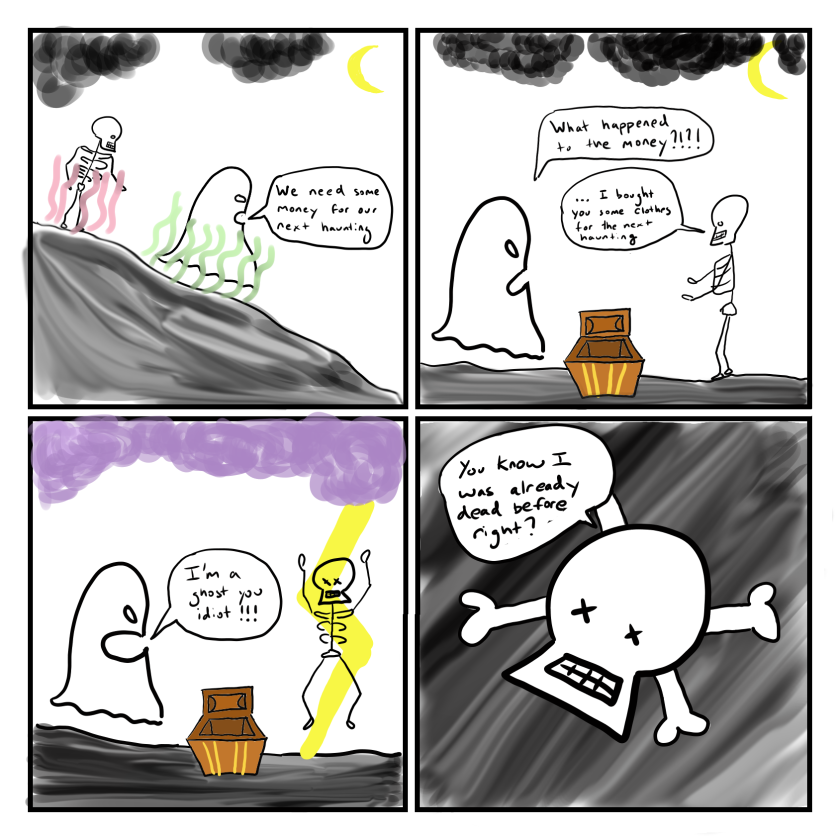
Spooky Money

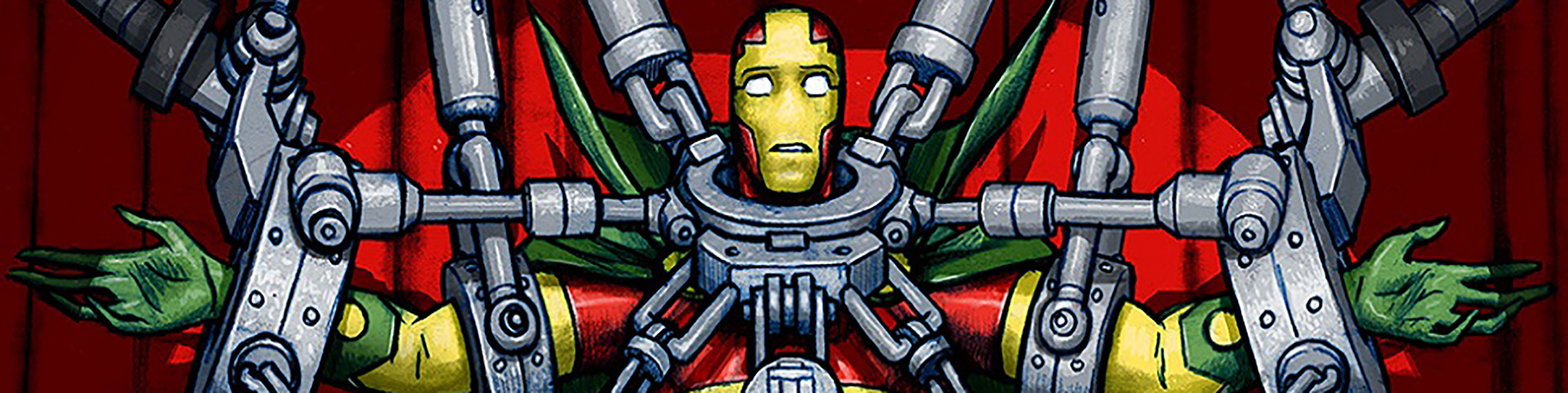
For the quadriptych I decided to make it using the same characters from my triptych. I wanted to see how the same or similar ideas would change from a triptych to a quadriptych. This piece is self-standing, but you can get some more interesting ideas if you read both this piece and the triptych. If you read this piece alone you might think that these two already know one another, but the triptych reveals that the ghost recruited the skeleton. Also, in the triptych it was unclear if the ghost could control lightning, but it looks like he can in this piece.

What was difficult about composing this piece was finding the right plot of events that would fit into the four panel style. I found it actually more difficult to compose the quadriptych than the triptych because you need a middle conflict that can be broken down into two essential panels. Each panel needed to be important such that when you remove one panel, it makes the story unclear. Creating the two conflict panels was difficult, but reading it as an audience, to me, felt more satisfying than reading the triptych because of that prolonged tension. The final panel is more lighthearted, giving a resolution to that tension which makes it satisfying to the reader. The beginning and ending panels still feel similar to the triptych because only one panel represented the beginning and the end. I think it would be interesting to see how to prolong the beginning/ending panels and what effect that has on me drawing it and me reading it.

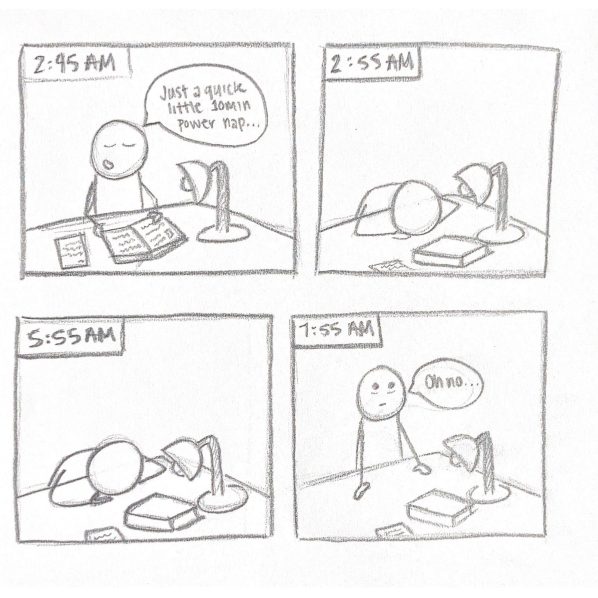
Power Nap

Four-panel comic drawn by Me

Throughout high school I would often sleep very late, staying up to finish homework and projects—sometimes pulling all-nighters. However, there was times in which I’d get really sleepy but still had something to finish so I would take quick 10 to 15-minute power naps at my desk to recharge then continue working. Unfortunately, those power naps were not always succesfully carried out. I would sleep the remainder of the night and realize it until it was time to get up and ready for school—my assignment also incomplete.

Crafting this quadriptych comic was a very fun process. At first, the idea of adding one more panel in comparison to our triptych was relieving since I struggled a bit with deciding what parts of the narrative should be presented, but at the same time now it was “I gotta think of more content to present visually from the narrative”. For inspiration, I went through some of my favorite webtoon comic Safely Endangered since the author often uses these triptych and quadriptych formats. The Safely Endangered comics are very simple and really funny; since a lot of them are based on “common” happenings, such as applying eye drops or waking up still tired, I decided to think about my personal common happenings. I sketched out two different possible panel compositions. The first two panels in my first sketch included a longer version of the dialogue in my final sketch, followed by only 1 panel of sleeping before the waking up panel. The second sketch was basically the draft of my final version: one panel with short dialogue at the beginning, followed by two panels of sleeping before waking up. I went ahead and chose the second composition because having those middle two panels stretch out helps emphasize the passage of time—which plays along ironically with my “power naps”. Compared to the triptych sketch, this felt similar in having to figure out what was most appropriate way to efficiently present my narrative. However this quadriptych was different not only since I drew it rather than base it off one photo, but also it felt like I could present a longer and more detailed narrative even though it’s only a one panel difference.

It’s too late for this.


The comic is about a student who is minding their business and realizes that their laptop and analog clock don’t match up. I didn’t know the time changed until this morning, and I was so disoriented because of it. I was trying to figure out if we lost an hour or gain one for like 5 minutes. My brain was not functioning today.

In the brainstorming process, I wasn’t sure what I wanted to draw, so I kept on starting something then erasing it. I kept on doing that for like 5 times, so I changed drawing platforms. Finally, I figured out a concept that I liked. I really wanted to portray a student who was so tired that they overlooked the time change and thought something was wrong with them. I thought the story would be funny ,and others will be able to connect to it as well. I liked doing the triptych comic better than this one. I think the extra frame made it harder for me to come up for a longer plot. The layout of the panels didn’t hinder me much.

Sketch 4: Quadriptych

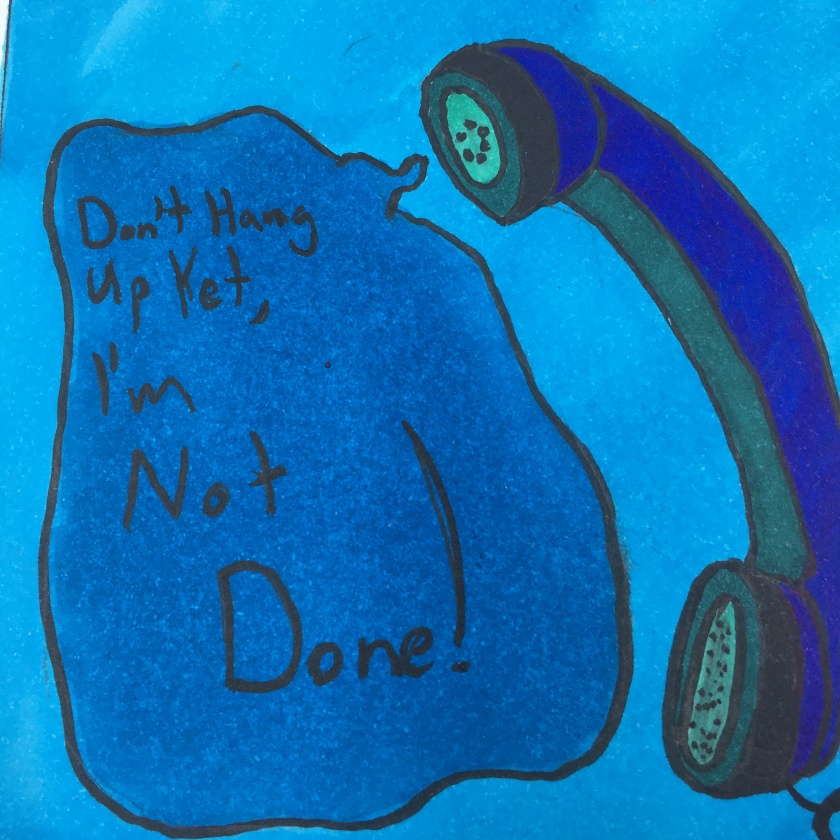
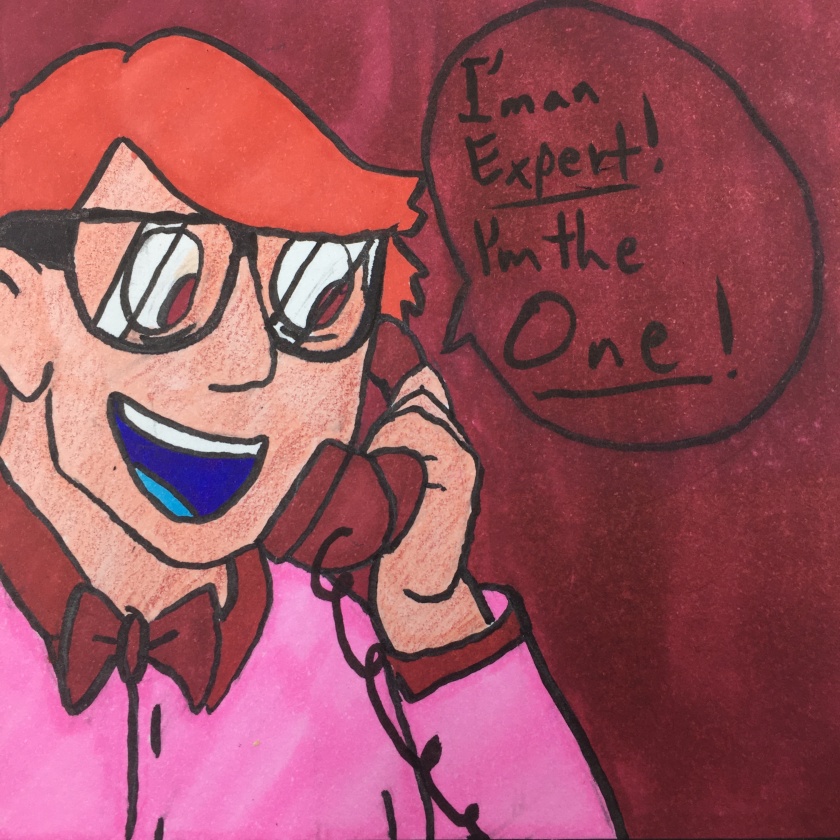
I was excepting my triptych and my quadriptych to be very similar going into this, however that turned out not to be the case. I wanted to continue Cat, Rat, and Bat but I couldn’t think of a way to fit them into a four panel comic. I was lost for ideas listening to Spotify when Touch-Tone Telephone but Lemon Demon came on and I got the urge to illustrate some of the lyrics. I still wanted to tell a story with the song so I tried to portray the narrative the writer was trying to tell with it. I also wanted to do more angles, since I had more space to tell a full and complete narrative. It’s not a comedic cartoon al well, which while different then writing for comedy, was still fun to write.

The Danger of Procrastination

For my Quadriptych I chose to make a story about procrastination. This is story was an example of some of the days I have been having this week. I chose procrastination because it is something that I have been doing a lot recently and I think many people can relate to it. This type of comic strip is a little longer than a triptych and because of that you have a little more space to develop the story.

Sketch 7 – Quadriptych

When thinking of an idea for my quadriptych, I initially had trouble. I was trying to make a story from scratch, and I could not think of anything. Then I started to think about my past memories, and I thought of this idea. As an older brother to multiple siblings, I have seen my parents grow more soft over the years. In other words, they always avoid trouble and get what they want from my parents. Hence, the concept of the comic. In the comic, a boy asks his mom if he could have a gum ball. The mom says no, but the little boy starts crying. After the boy cries, the mom feels bad and buys the gum ball.

Overall, I thought the quadriptych was easier to make than the triptych because the extra panel allowed for more creativity and the opportunity to develop more of a plot. If I would make this comic a triptych, I would not have included the close up of the boys face with the tear. Without the inclusion of this panel, the meaning of the comic would be quite different.

Sketch 7: Quadriptych

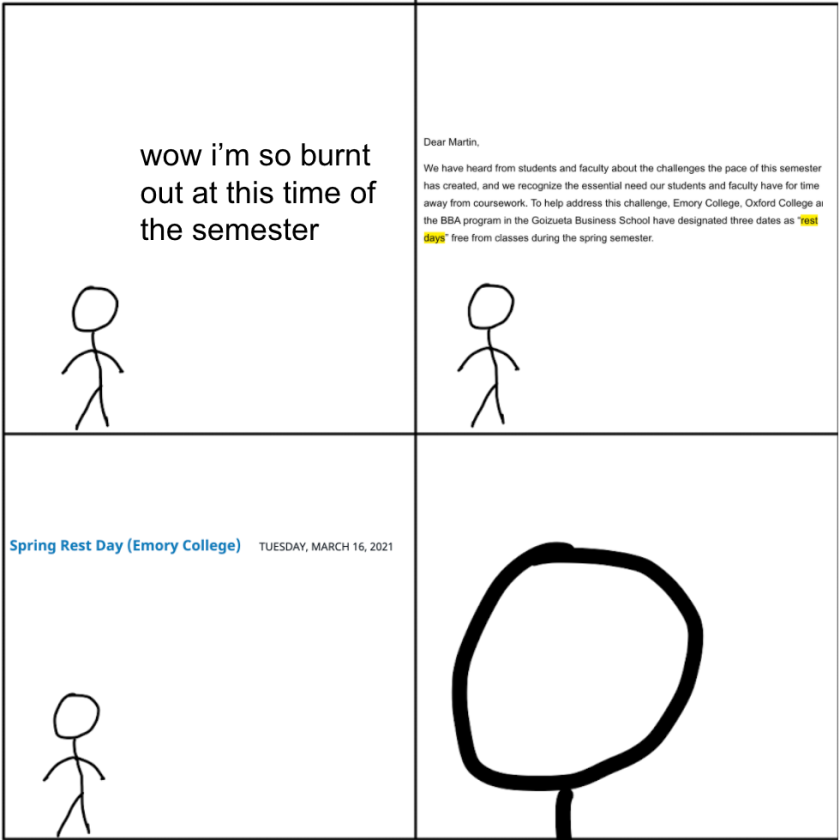
This comic was inspired by the rest days the university had decided to put in place to ease the marathon of a spring semester. I chose to draw a stick figure instead of using a picture like my Triptych to switch it up and give it a more “personal” and “amateur” feel. I used a text box to match the screenshots I took from official emory communications about rest days. I think this type of comic strip was easier for me to make because I am more used to the 4 panel comic structure I see a lot on instagram, facebook, and reddit. I think the added panel allowed me to have more space to develop a story which was much harder in the three panel. I used the middle part to develop the bandaid type solution that the college had provided. I chose to tell this story because it was all I had been thinking about all week.

css.php