The Secret Language of Comics

Literacy Narrative Part 3 Reflection

As a whole, the literacy narrative project has helped me achieve many of the learning outcomes for this class. The process of transforming my written literacy narrative into a comic allowed me to write across different genres and formats. I used technology for the large majority of the process, more so in making the comic version. I published the different formats of the narrative to my website, a digital platform. I used an app to create my comics, with the use of typed text, images from the Web, and other technological elements. Overall, the process involved the repetition of research, drafting, editing, and reflecting. I went through multiple drafts of the written text to make sure it sounded good and the comic in order to see which format of frames I liked the best. After getting feedback from classmates and other peers, I implemented changes so that my comic would be a better experience for readers. As I edited the comic, it inspired me to make a few edits to the written text as well. I was then able to rewrite the narrative back into text form based on my final comic.

It was interesting to return to the alphabetic narrative after finalizing my comic. I think the comic was really helpful in that it helped me simplify my narrative. This is meant in a good way – I was able to get rid of unnecessary details and make the actual story shine through. In my first drafts of the written narrative, I included a lot of fluff and I honestly didn’t have a clear path for the story to follow. After reviewing the comic, I decided to focus specifically on my public library experience rather than talk about my experiences outside of that realm. I am glad I made this shift because it made me feel more grounded and I could actually analyze the effects the realm has had on my perceptions of reading and writing. Also, I think it has a positive effect on readers in that they don’t have to go between distinct, vaguely connected ideas. In the earlier drafts, it seemed like certain parts of my narrative went along with different “thesis” statements, which could be confusing. My views of these memories has also been focused in a way. Instead of a general comment about how reading and writing is no longer fun to me, I now think about how these activities are still fun to me, it’s just my perspective changes depending on the setting. At school, I dislike them because it feels forced and stresses me out. However, at the public library, I am relaxed because to me, it symbolizes freewill and exploration based on past experiences.

Link to narrative rewrite: https://selazzioui.wordpress.com/literacy-narrative-part-3/

Literacy Narrative Pt. 3 Reflection

Returning to the written narrative after creating the comic version forced me to change the flow of my original story. I had a more concrete idea of the message I needed to relay so I adjusted the alphabetic narrative to be more straight to the point. I decided to dive right into my first memory and edit some of the unnecessary “fluff” from the narrative. I, also, added some more visual descriptions of my setting and scenario that were revealed in the comic version. It helped me see the story through an actual image which I brought back to my written narrative. My analytical thinking process was relatively similar throughout all parts of this project, but after making it into a comic, I was much more to the point with my analysis. I incorporated that back into my written narrative, making it more straightforward. I learned to take adjusted ideas from another medium and apply them back into a written work. It was definitely valuable to go back to the written narrative after making the comic, even just to see the different approach I took when telling the story through images.

Triptych

When coming up with the narrative, I wanted to make it humorous. In order for the three panel comic to to have an ending, the joke had to be said on the third panel. In order for the joke to be on the third panel, that means the first panel and second panel had to set up for the third panel. In order to create of a humorous triptych, I had to think of a joke that would fit in three panels, so I scanned my surroundings for help. Unpredictable weather has been a trend since I’ve been on campus since first semester. Sunshine and high temperatures followed by sudden rainfall is the basis of my triptych. The challenging component of this assignment was finding a narrative that fits in three panels. I had a couple ideas but many of them required more than three panels. This comic strip is similar to the tracing assignment. One of the ways I annotated/analyzed the Spinning and Stitches pages was by identifying the choice of motion of the panels. I can identify the choice of motion just as I did for the tracing assignment.

Am I Loving Myself Enough?

Self-care visual representation

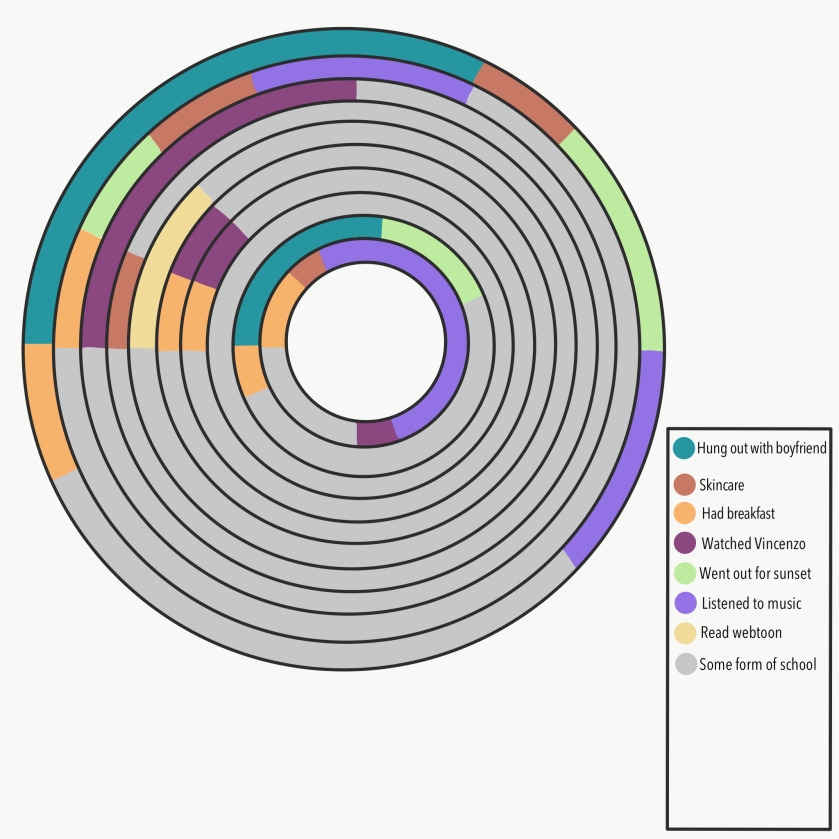
For this Sunday sketch, I decided to track how much I love myself by doing things that are healthy for myself—such as having a good breakfast and keeping up with my nightly skincare routine—and taking time for hobbies/activities that help me relax during my waking hours and give me a break from school, then comparing it to the time I spend doing any type of studying or class work.

Starting this visual data gathering assignment, I wanted to try and manage my time well enough so I could have time for my relaxing activities and therfore create a nice colorful visual. Unfortunately, this past week wasn’t my best and I didn’t have the motivation to bother much—I didn’t even setup my weekly bullet journal spread, which is what helps me stay on track and manage my time. Even though I didn’t successfully manage my time these past days, I usually don’t have much time to relax during my waking hours either when I do actually try, so this visual is at least 50% accurately representative of my standard lack of self-love. To represent my data, I made this circular graph split into 10 bands to each represent a day since March 18. I then split the days into 16 sections to represent the average hours I am awake per day. I then colored in the amount of time I spent each day doing something I enjoyed, such as watching my current favorite K-drama Vincenzo or going outside to view the sunset and take pictures of the sky—each activity is color coded—then the grey shaded area of each band represents time I spent stressing and struggling with school work in any way, shape, or form.

As I mentioned previously, my days already are quite packed with school work even when I am “managing” my time, but seeing data visually represented makes me realize this is not okay; diminishing the focus on my own mental wellbeing and not caring for myself for the sake of trying to focus all my energy towards school doesn’t seem right nor healthy. I need to create a balance between spending energy on school and spending energy and focusing on things that I love and healthy habits for my own good—literally if I was to just get used to having breakfast every morning I’d start off more energized and motivated on a daily. I think this was a valuable tool for self analysis; literally showing me upfront how bad I am at doing things for self-enjoyment without feeling bad about not being productive in terms of doing school work. If I was to continue this project in the future, I think I would switch to creating journal entries at the end of the day to keep track of my happenings before then creating a visual chart representing how I spent the day and what where the things I did for myself and not school.

Week Ahead: 10

3/28 Data gathering for sketch 8
10 3/30
  • Sabrina –158-204
4/1
  • Good Talk chpts 1-10 (pp 3-85)
Literacy Narrative, part 3

This weekend, you should finish tracking your data for sketch 8 and publish your charts as a sketch post to your site. Identify what conceptual issue you were tracking or what question you wanted to answer (or begin to answer). Include 2 or 3 paragraphs explaining what conclusions you have drawn from the data that you collected. I hope this has been a useful process for all of you!

This coming week, we’ll wrap up our reading of Sabrina and begin to read Good Talk by Mira Jacob. Good Talk has popped up on many best of lists last year in the aftermath of protests last summer and in the run up to the elections because of its place in the national conversation about race.

Literacy Narrative Comic Reflection

To be honest, this comic assignment was a challenge for me. When I first knew that there is an assignment that I have to draw a comic, I was so panicked, since I am not a good drawer and I was not confident to convert my written task about my experience that shaped my writing skill into a visual comic. At first, I was struggled with this, since I felt like I was losing a lot of the details and it was hard to choose the right frame that fits a page and goes well with my drawing. I had some useless spaces left on the page, because I could not pick a perfect frame. Also, showing the atmosphere of the situation and feelings of that characters through my deficient drawing skill. It was annoying to have a clear image and specific vision of what I wanted my drawing to look like, but it was not possible to actually realize it due to my lack of skills. However, the more I drew each page, I could feel that I was improving my skills of choosing the right frame and showing a clear storyline on each panel. 

After I struggled and finished my comic with the peer feedback, I realized that the details are just shown in a different way through the process of arranging and editing. Since the main events and important parts of my writing were in my comic, there was no problem understanding the story and message, even though there were fewer descriptions. Through drawing a comic, I could even have a better understanding of my own literacy narrative. Also, I could find some unnecessary parts that I have to get rid of and significant parts that I have to focus more on when I write my literacy narrative 3. I have been taught to easily find the main important parts from my essay and compose written texts in a comic. This assignment was a rewarding experience, even though there were challenges that I had to overcome. 

My final Literacy Narrative Comic

Comic Reflection

Writing my literacy narrative as a comic was a challenging but rewarding learning experience. Writing out the narrative was something that I had done before, so it was familiar. While translating my writing into a comic was new and came with its own set of challenges. Some difficulties mainly were about what angles I wanted to include and how to get the main point across. When I created the draft for my comic, it was challenging to choose what words I wanted to have and how they helped develop the story. The first draft of my comic had an issue with wording, and it took away from the primary goal of the story I was trying to present.
Translating my Literacy narrative into a comic allowed me to understand the time and energy of creating a comic. The different choices that authors make allow their story to progress excitingly. In my literacy narrative, many of the details needed when you write a story translate a little differently when you are writing a comic, like time. When you show the progression of time in a written narrative, you can time jump and use ellipses to show change, but in a comic, you can use more panels and perspectives to change how the reader perceives time. Time perception is crucial because it can help the reader understand the importance of certain events and memories in the narrative.
In my comic, I choose to include color on some panels to show emotion or lack thereof. On the classroom panel, I decided not to color it because I wanted the reader to understand that reading in school was a dull experience. While in other panels, I choose to include pale colors and bright colors to show a change in emotion. On other pages, I had many panels on the pages that all offered a different perspective of the same image. This setup goal was to show what I imagined in my head before zooming out into reality on the next page. I don’t think I got many different perspectives in my comic because it was challenging to draw the different stances; I wanted to be straightforward to the reader. Overall, drawing my comic was fun and a little scary because I represented my writing differently.
After I completed my comic, I felt that I could add a lot more to the pages, but I did not have enough time to do so in a way that would be the best representation of my work. My comic could be more in-depth in certain scenes, but while creating it, I felt that if I added more pages that only centered on a specific moment, the comic would not have been clear.
So I sacrificed the length of my comic to have more detailed panels with more color and emotion. The colors and emotions they evoke are essential to the story because it allows the reader to have a more personal connection to the work. Also, the colors make the pages more vivid and entertaining for people who are reading.

The final Comic

Comic Reflection

Writing my literacy narrative as a comic was a challenging but rewarding learning experience. Writing out the narrative was something that I had done before, so it was familiar. While translating my writing into a comic was new and came with its own set of challenges. Some difficulties mainly were about what angles I wanted to include and how to get the main point across. When I created the draft for my comic, it was challenging to choose what words I wanted to have and how they helped develop the story. The first draft of my comic had an issue with wording, and it took away from the primary goal of the story I was trying to present.
Translating my Literacy narrative into a comic allowed me to understand the time and energy of creating a comic. The different choices that authors make allow their story to progress excitingly. In my literacy narrative, many of the details needed when you write a story translate a little differently when you are writing a comic, like time. When you show the progression of time in a written narrative, you can time jump and use ellipses to show change, but in a comic, you can use more panels and perspectives to change how the reader perceives time. Time perception is crucial because it can help the reader understand the importance of certain events and memories in the narrative.
In my comic, I choose to include color on some panels to show emotion or lack thereof. On the classroom panel, I decided not to color it because I wanted the reader to understand that reading in school was a dull experience. While in other panels, I choose to include pale colors and bright colors to show a change in emotion. On other pages, I had many panels on the pages that all offered a different perspective of the same image. This setup goal was to show what I imagined in my head before zooming out into reality on the next page. I don’t think I got many different perspectives in my comic because it was challenging to draw the different stances; I wanted to be straightforward to the reader. Overall, drawing my comic was fun and a little scary because I represented my writing differently.
After I completed my comic, I felt that I could add a lot more to the pages, but I did not have enough time to do so in a way that would be the best representation of my work. My comic could be more in-depth in certain scenes, but while creating it, I felt that if I added more pages that only centered on a specific moment, the comic would not have been clear.
So I sacrificed the length of my comic to have more detailed panels with more color and emotion. The colors and emotions they evoke are essential to the story because it allows the reader to have a more personal connection to the work. Also, the colors make the pages more vivid and entertaining for people who are reading.

The final Comic

Literacy Narrative Part 3 Reflection

I think the overall literacy narrative project helped me meet the learning outcomes of this class. By creating both a comic and an essay, I expressed my thoughts and ideas using different modes. I also went through an entire process of editing and revising my literacy narrative, which helped me improve it drastically. Overall, this project allowed me use all aspects of my current skills, and pushed me to develop more skills such as web-design and drawing.

After drawing the comic, I felt that it was easier to return to the alphabetic literacy narrative. When I was creating my comic and revising it, I realized areas where I need to emphasize more and areas that were unnecessary. This helped me gain a better perspective on my essay as I understand it better from the readers’ viewpoint. After working on my literacy narrative in a visual format, I also found that both the visual and alphabetic format has their advantages and drawbacks. It is easier for the readers to understand what I am saying in a visual format, whereas I can use the readers’ own imagination about the words that I write in an alphabetic format.

Now, I see the story that I am trying to tell more cohesively. Before, I feel that it was a bit fragmented. With some pieces not adding up or being at the wrong place in the story. Now I think I have improved the flow of the story, which makes it easier for the readers to follow along.

Literacy Narrative Part 2 Reflection

Creating this literacy narrative comic was most definitely completely different from any other previous writing I have done. It was also extremely challenging all the way through the process. I think this entire writing process really emphasized the challenges brought up by the learning outcomes for this course. By reading three comic books—Stitches, Spinning, and Kindred—during the process of working on this literacy narrative comic and discussing those works along with reading additional texts such as Making Comics by Scott McCloud, it created the foundation for me to start thinking more in-depth about how these works are composed. 

Previously, I have read multiple comics, but I have never processed them as thoroughly as I have done in this class. I feel like in the past while reading comics, I only absorbed the reading as getting an understanding of the plot and having pretty visuals to go along with it—almost like a children’s picture book, but yet because there is usually more content it felt more “mature” reading. That mindset of comics basically just being the visual version of some story’s transcript is probably what made it quite challenging for me once I actually started working on making my comic based on my alphabetic literacy narrative. I wanted to represent my narrative visually, basically word for word. But, the thing I have learned about comics is that the author must really think and strategize about how much information they provide for the reader; it cannot be too vague, but just enough that the reader can understand what is going on without being confused and if there are minor details left out, they can make their own assumptions—based on what the author has already provided. This also caused me to re-write my alphabetic narrative so I could have a clearer idea and organization of what I wanted to depict through my comic.

Because comics implement both words and visuals to present a narrative simultaneously, I decided to make my visuals a combination of images that literally depict whatever explanation I give in the panel as well as images of specific subject matter that remain stored in my photographic memory. While at first, I was unsure of going with that approach because it did not feel much like a “story” as compared to the comics we have read—rather it reminded me more of the Romeo and Juliet “Draw My Life” video I did back in eighth grade—I then realized it is a story, but it simply does not feel the same because I am not using over two hundred pages to tell it. 

That realization made me feel a bit more confident in my comic. I wish I could have implemented more thoroughly thought-of and cool choices of moment and choices of frame in my comic, but I think that since I did not have the time to make a whole book with a fuller story for each section—with that “in the moment of action” vibe that can be presented through moment to moment panels—it was what limited my choices a bit. This made me focus a bit more on my choice of image and choice of flow. Just like my choice of image, I wanted to make my choice of flow easy for the reader to follow along. Just how the memories progress with time in a pretty linear manner in my mind, I wanted to depict that. Additionally, in my first rough draft sketches, I was planning to include multiple panels per page, but I decided to cut some off and rearrange the composition on several pages to try and make a clearer distinction of the sections/moments in time I talk about.

css.php