The Secret Language of Comics

Literacy Narrative 1 Reflection

I feel very uncomfortable writing something like this, not because of the content of what you are about to read, but because I have never done something like this. I think starting with a free-writing exercise threw me out of my comfort zone, which translated to the narrative. The free-writing was a creative work, something far removed from the analytical writing I was trained to do. In my literacy narrative, you will get a brief progression of experiences that lead me to my current perception of reading and writing—analytical, puzzle-like. Though writing and reading started from an imaginative process it eventually become a bit mechanical.

Looking back at this narrative, I can see that this still holds true. I can see the seeds of creative writing elements in the stories I tell. There are glimpses of storytelling, but they are trapped behind a somewhat mechanical and segmented analytical style. Had it not been for the free-writing exercise, these elements may not have been present in the narrative. I hope to get more comfortable with this, and I want to see where this can take me. Perhaps I can rediscover that imaginative feeling.

Literary Narrative Part 1 Reflection

Before doing the X-pages exercise, I did not know how I was going to respond to this prompt. I knew that my 10th grade English class was by far the most memorable and pivotal experience I had, but I also began to remember forgotten memories. After creating my list of ten memories for the X-pages exercise, I chose the four memories/experiences that were the most essential to my development as a reader and writer. As shown by my piece, these memories were reading To Kill and Mockingbird, Romeo and Juliet, Indian Camp, and, of course, my 10th grade English class. I chose these memories because they showed a steady progression of my progress and were the most resonant with me.

When I first began writing, I was shocked with how much I truly remembered from these memories. In fact, I remembered so many details, that I had to delete some unnecessary details upon my first proofread. By doing this, my hope was to more directly show my progression as a reader/writer. If anything, writing this essay was very reflective and enlightening. Partly the reason why I feel this way was that I did not write too many personal pieces in high school. Since my essays in high school were always about the fine details in a piece of literature, I found it refreshing to write something about myself.

Literary Narrative Part 1: https://thomasczickeng181.wordpress.com/literacy-narrative-part-1/

Literacy Narrative 1 Reflection

Original Post

Writing this assignment overall was pretty easy for me. I have spent a lot of time reflecting on what I don’t like about writing and what might have caused it so I could develop writing strategies that work for me. I did the writing exercises knowing that that moment didn’t really define my relationship with writing for the majority of my life so writing the start of my piece was a little more challenging than the last part but it was still easy since those memories have stuck so clearly with me. 

When writing this did make me realize exactly why I do love playwriting. Playwriting you still have to worry about grammar and spelling of course but not as much as a novel. The main chunk of the piece is going to be dialogue and most people (and certainly most of my characters) don’t speak in perfect grammar, but rather in their own languages. 

I think the most interesting sentence is “I’m left handed so my writing tends to smear” since that line is actually handwritten and then smudged over to show the audience a (admittedly exaggerated) version of my messy handwriting. But picking a sentence in the text itself I’d have to say is would be “I had refrained from putting my best into essays because if I did less than great than hey, I know I could do better.”, since I feel like it is a sediment that at least a chunk of my generation has carried with them through high school. 

Literacy Narrative Reflection

I had been dreading this day, but finally, it came: the day I start my Common App Personal Statement. I stared at my computer screen thinking, trying to put something on the blank page, but nothing came. I truly had no clue where to begin. I didn’t want to write about my involvement in sports or my love for marine biology, they were too cliché; I had to write about something unique to me. Then it hit me: write about my brother.

Prior to junior year, writing had never been my strong suit. I was creative but could not put pen to paper in a transparent way. My old essays are filled with misplaced “howevers,” bad transitions, and very choppy sentences. That all changed junior year with a combination of ACT prep and a brutally hard English class. For me, junior year was a writing bootcamp.

I credit my mechanical improvement to my tutor Mikey. The Berkeley graduate spent hours working with me, forcing me to memorize the various grammar rules for the English section of the test. Slowly, throughout the first semester of junior year, I picked them up. I was able to work through the English section with relative ease. I was proud of myself for improving this much. I went from below average to near perfect on the section, it was clear my mechanics had improved. What I had not realized, though, is how it transferred over to my writing.

Ms. Everett is notorious at my high school for having the hardest class. At the end of the semester, kids come finish smiling with a C. So, going into her class I was obviously worried about the potential to have my GPA crippled. And, after the first week, I was well on track. My first quiz came back an 8%. It was a pop-quiz on the syllabus I had not read, but still, I was scared. The fact that there was a pop-quiz on the second day of school meant I had to always be prepared. Regardless of how prepared I was, it didn’t stop me from getting a C on the quiz the following day. There was little feedback on my short answer questions, so I scheduled a meeting with her. Even though this was the first one-on-one conversation I had with her, she treated me like I was an old student of hers – she got straight to the point. She told me my mechanics are off, that I change tenses, I can’t transition among other things. I knew I had to put in work if I wanted to succeed, and that is exactly what I did.

I spent countless lunch periods and after school sessions meeting with her. After every assignment, I was in her room asking for feedback. As the semester continued, it was clear my writing was improving. The combination between Mikey’s ACT prep and Ms. Everett’s one-on-one sessions, I began to feel confident in my ability to write.

Once it hit me, to write about my brother, I Instantly began to type all ideas I could on the page.  My brother has autism, but I knew writing about just that was not enough. I didn’t want it to be a pity, sob story, but I wanted to write so other people were able to understand what it was like having an autistic sibling. I ended up writing about my experience’s scuba diving with him, showcasing how under water his nervous ticks and visible anxiety disappear. How, under water, he is the same as anyone else, and, above water, he is just trying to be understood.

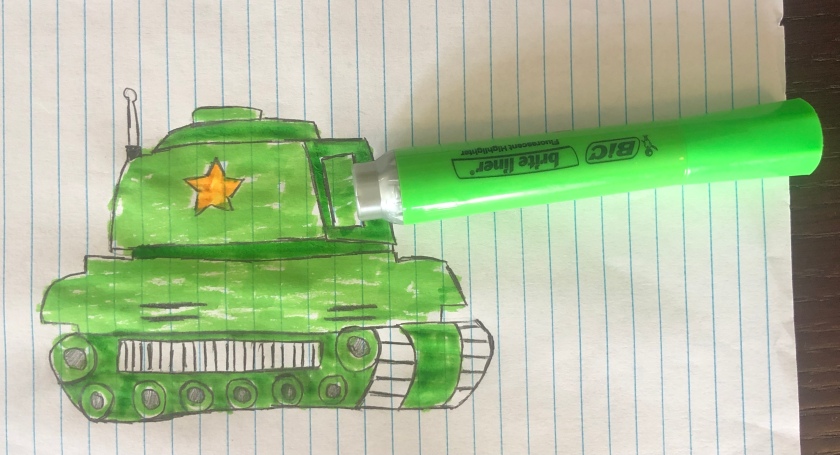
Ink Tank

As I was reading the instructions for Sunday Sketch 2, I looked at my desk and saw a bunch of highlighters. The first idea that popped in my head was to make a nickelodeon green slime gun with the green highlighter as the barrel of the slime gun. I didn’t know how to make the gun look cool and toy-like, and it ended up just looking like a green colored gun. I felt that even though the slime gun would’ve been a cool concept, it was slightly inappropriate and didn’t want any trouble coming from this sketch.

That’s when I thought of a cartoon tank with the green highlighter as the turret of the tank. I tried my best to make the tank look cartoony as possible by down-sizing the body of the tank to make the “turret” (green highlighter) unrealistically big.

Literacy Narrative Reflection

I was not taught how to write a narrative during high-school. Instead, I was taught the classic five-paragraph essay that every student knows how to write. Hence, when I was writing the reflection, I felt, for the first time, freedom when I am writing. It felt like that I could write and say anything I want without worrying about the overall “structure” of the essay. Likewise, I wrote my narrative in the same fashion, free without worrying about structures.

After writing this narrative, I was surprised to re-discover that I really write like how I read. I almost had forgotten this feeling since the last time I truly wrote something as free and creative as this narrative was likely during elementary school. The years spent learning how to write using certain structures have shaped me into thinking that all essays required aspects such as introduction, conclusion, thesis, etc. Whereas in reality, I can write however I want as there are no true structure when it comes to essays.

From the readers’ perspective, I think this narrative could almost be viewed as a story. I spent a large portion of the narrative writing about my memories of my father, which I enjoyed very much. The picture of my parents also help the readers associate a face with the figure of my father, which can make reading easier and more interesting.

Narrative page: https://ericeng181.wordpress.com/literacy-narrative-part-1/

Literacy Narrative Reflection

Link to Literacy Narrative, Part 1

The writing process for this literacy narrative went better than I thought it would. Since middle school, I have written more book analyses and scientific reports than creative, personal writing pieces. The freewriting exercises we did prior to this assignment definitely helped with my creative flow. I had brainstormed and put down a lot of descriptive details about the events I included. When it came time to start writing, I was easily able to write the parts of the narrative about my experience in detail. However, it was trickier to write opening and closing lines because I wanted to make interesting points that drew the reader in and left them satisfied.

“Some things may have changed, but the feelings I had originally felt during our visits instantly returned every time I stepped foot into the building.” This is one of the most interesting lines from my narrative. It reminded me that I am a reflective and nostalgic person. I think it was somewhat easier to talk about my previous experiences with reading and writing because I reflect on my memories from the past on a regular basis. I tend to remember things I experienced in greater detail than other people who were with me who barely remember anything. While writing my narrative, I found it both comforting and sad to reminisce about my childhood and all of the fun memories I have from that time.

Literacy Narrative: Writing About Me

At first I was very stressed about this writing assignment. I am an analytical writer. The formulaic method is comfortable for me. All types of creative writing are out of my comfort zone. Starting with the free-write exercise helped immensely. I was able to get my story ideas down as well as describe them from all the specific questions (something I struggle with). You will read about a core childhood memory and a recent school memory and how I found them to be similar. While writing this narrative, I learned that I am able to enjoy reading and writing if I can somehow tailor it to myself. What’s ironic is that writing this literacy narrative, itself, proved the point of my paper. Because I wrote about myself and memories I love sharing, I enjoyed writing it. I have limited myself to analytical writing to “get by.” Hopefully now I can practice different styles to improve my writing altogether.

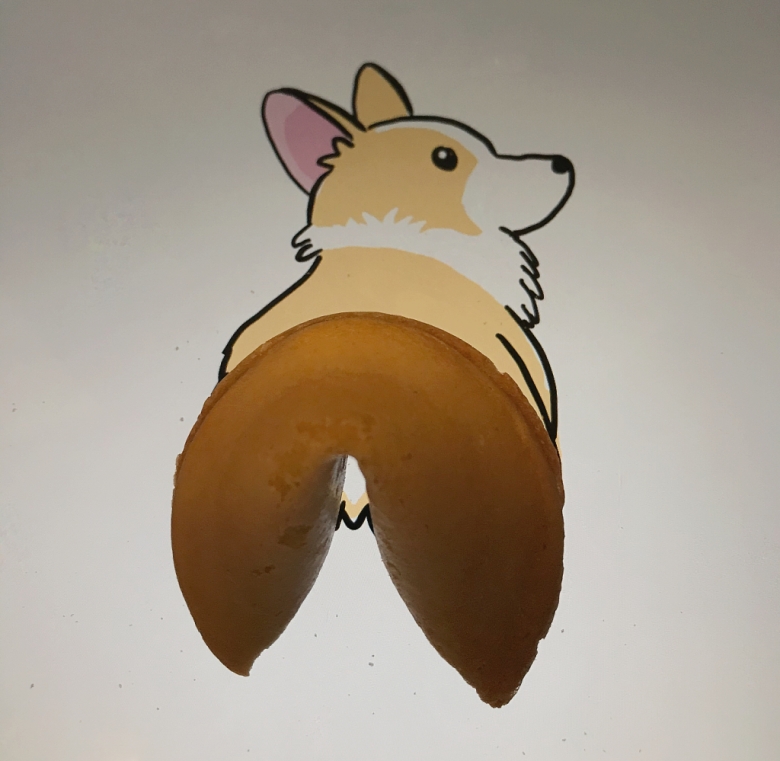
Being The Butt of the Joke is No Fun

I feel like I’m constantly the butt of the joke from the fortune cookie gods.

As I scanned my room for an object, a measly remnant of my Chinese takeout caught my eye: a fortune cookie. Normally, I’d excitedly open the package, crack the cookie in half, read my often dismal fortune, and eat the cookie to soothe my superstitious soul. Last week, my fortune said that I have a lot of problems! That day, I was so busy, I forgot about the cookie. I thought I could use the cookie for my sunday sketch, but figuring out an idea proved harder than I originally imagined. I tried a couple of ideas—UFO, Asian conical hat, hair—yet none of them really worked. The odd, crimped, protruding shape of the cookie was working against my favor, and any minuscule change in the camera angle drastically altered how the cookie looked.

On Sunday night, I held the cookie in my hand, trying to ignore the urge to crush it into pieces and give up. I thought “Haha, this kind of looks like a butt.” I instantly dismissed the crude idea, but the more I thought of it, the more it seemed to fit. Yes. A corgi butt. I immediately got to work on my iPad, and voila! Fortune cookie butt! I then edited the photo to adjust the lighting and dimensions and felt happy with the final product. Now, I’m currently eating the cookie while reading my fortune about failing at the stock market (I don’t know anything about it). I think I’m going to start kicking the fortune cookies’ butts and decide my own future.

Finding the Light

Although 2020 has come to a close, our lives will forever be stained by its events. With the pandemic, social injustice, and economic distress, all we can do is search for the light.

Ironically, as fire usually can represent chaos and anguish, its one of the most original forms of light. We have endured a year of chaos and anguish, and can turn to a brighter year. The year of 2021 can prioritize recreating hope amongst all individuals affected by 2020.

I explored multiple items for this weeks “Sunday Sketch”: keys, iPhone chargers, and even food. I finally decided to use a lighter to reflect on simpler times, when fire was the most common form of light. Not surprisingly, I came up with this idea because my roomate watched CBS’s Survivor right next to me, a show where contestants have to sustain themselves in the wild as they endure social challenges. I couldn’t help but seeing the humor in how we find it entertaining to watch people like us live like they’re in the stone age.

css.php