The Secret Language of Comics

Literacy Narrative Comic Reflection

After completing my comic, I realized that the work that I have done reflects the learning outcomes of the class. Firstly, comics involves multiple types of literacy, and to complete my comic I used multiple modes communication to express my ideas and help the readers understand the plot of my comic. Whether it be using different colours or sizes of panels, I used different techniques to help the readers realize what is significant and what is not. Also, the entire process of completing my comic involved several steps from making the first draft of my literacy narrative and the comic, to editing it and turning the final copy into the final comic. This showed that I practiced writing as a process, drafting and editing my words while writing reflections like this. Finally, I used technology appropriately as I used my iPad to sketch out my comic and revise it into the final copy. If the same process was done on paper, I think it would’ve taken more time and would not be as efficient. 

Overall, I think it is different to write my literacy narrative as a comic. As a comic, some of the aspects of the literacy narrative had to be turned into a visual representation, and after those aspects were added, the story itself became more obvious as to how I became a reader. I feel that I did not need to explain as much in the comic as the essay since I could show certain things using images directly. I also realized some of the unnecessary details in my alphabetic literacy narrative that does not contribute to the bigger plot or storyline. I think turning my literacy narrative into a comic helped me see it from the readers’ perspective, and I really realized what I need to include in both formats of my literacy narrative to make them better. 

When creating my comic, I had to select only the important events or details to include. If I tried to include every single detail, my comic would be very long and hard for the readers to follow along. This realization came after looking at my old comic and the feedbacks. I thought about how my comic would look from an outsider’s perspective, and some of the panels simply did not make sense. Also, I tried to make the comic all the same colour except for important details or events. I made everything black, with occasional usage of red to emphasize certain moments or details. I also added some panels with only words in them. This gave my comic a sectional feel, and it is easier for the readers to follow along my journey that I described. Overall, I think I used some writing techniques when composing my comic, which I learned from other assignments that I competed this semester. 

Comic can also be found here

Comic Reflection

I mentioned this in class but it was a challenge determining how to layout my comic, since with essay’s the only things writers really have to worry about is where to break off a paragraph. It was also fun to choose how to visually represent certain things, such as my repeated failures in 4th grade or the “FCAT” taking the forum of a pure black cat with judgemental eyes. Another difference was, for my comic, a lot of stuff I liked in my literacy narrative had to be left out. I wanted to explain why I struggled so much as a kid in school but I realized that the reason why I struggled didn’t matter as much as the effect it had on me and what I had to do to overcome the fear I gained from the FCAT. This did help be to see my story in a different way. It is so easy to be mad at that situation but writing it out then drawing it made me realize how little that event really was in comparison to the impact it had on me.I had to think more about how this event actually changed me. In the future whenever I have to analyze writing I can’t just focus on any single part, events that happen on just page one of a book can have effects lasting all the way to the final paragraph. 

In my comic I had to take a, well let’s call it a “minimalist” style. I had to sacrifice backgrounds for the sake of time (and sanity). If I had more time or artist skill I would have loved to add in backgrounds, seeing the school background slowly progress from elementary to middle to high school would have been a nice effect. I’m also pretty lousy at drawing still, especially real people. I simplified faces a lot just so I could save time and I didn’t have to look up 800 references. It would of also been nice to just make it longer, there was a lot of stuff that’s important to me that I had to leave out. It’s hard to tell my entire 19 year long journey in writing in just 4 pages, and I didn’t even get the chance to touch on my experiences with reading and the burnout I felt at the end of highschool. 

Literacy Narrative Part 2 Reflection

Drawing this comic was a very enjoyable experience. I did not end up sticking to my original written narrative in part one. Instead, I took certain elements from the written narrative and weaved it into a different story. This helped in creating a more engaging comic because this new story had more visual potential than the recounting of events that led up to my writing style. The written narrative was more linear, and I did not think that it would make an engaging comic. When I came up with my idea for the comic, ideas started going off in my head, almost in a sporadic and non-linear way, which was the opposite of the original. This worked well for the comic medium because I could arrange my ideas spatially in two dimensions rather than the linear one dimension. My many ideas lead me to make a series of choices, but once they were made through the storyboard draft, it felt much easier to draw this comic than it was to write the narrative.

The first page is most similar to my narrative. It is almost like a traditional comic where you have three panels and images and text inside them. Instead of regular side-by-side rectangular panels, I decided to use overlapping puzzle pieces. This not only hints at what is to come in the comic, but also creates early conflict because the overlapping puzzles block the audience’s view of the scenes. I hoped this conflict would encourage the audience to continue reading and find the resolution of the first page in the last page, where a completed puzzle can be found.

A lot of what I am trying to do in this comic is to encourage the audience to read outside of the panels by going against convention. The second page uses squiggly rectangles as panels. This creates a connection to the bottom panel on the first page where I am thinking, but also echoes the traditional thought bubbles in most comics, in order to signify that I am talking about my thoughts. I also try to push the readers to look outside the panels by drawing a web that connects the second panel to the others. Thus, creating a story that is not bound by the panels.

The third page combines the puzzle piece theme and the squiggly rectangle theme, bringing some sense of resolution from the two drastically different panel styles in the two previous pages. Despite this, the worm’s eye view perspective of the scene highlights the difficulty of the task, which ultimately resolves in a nice fitting puzzle in the last page, concluding both the story in the panels and the story outside of the panels.

Overall, this was a very fun process. I think that this medium really brought out my creative side compared to the written narrative. If I had more time, I would probably try to incorporate some more detail and color. Right now, it is monochrome, and I don’t think there’s any particular significance in the colors I use. I wonder if using or adding different colors will change the meaning and story of the comic?  

Tracing Stitches and Spinning: Reflection

Stitches and Spinning both utilize a litany of literary conventions to assist the audience’s reading of the text, but Stitches focuses on establishing an emotional reaction from the audience whereas Spinning’s conventions focus on emphasizing the understanding of the plot. When annotating Stitches, I recognized that the panels consisted of vibrant pictures with little to no text. In addition to the action to action panel based motion, Small attempts to deliver an emotional reaction from the audience. On the other hand, Spinning delivers character thought based panels, utilizing facial expressions and internal dialogue to portray the mental state of Tillie, the main character. 

While tracing the papers, I became more aware of the facial expressions of the characters and the details of the settings within the panels. Being more aware of the imagery used by the author, I had a greater understanding of the emotional state that the characters were in. Tracing the outline of the panels accentuated the importance of the flow of the panels. There is no defined direction of the panels so it is up to the author to create effective flow of the panels for the reader to easily follow along. Annotating the comic pages consisted of more elements to consider. Analyzing the text within the panels was not much of a priority, but instead, I found myself interpreting the motion of the panels and the imagery. 

Traditionally, I would initially formulate a thesis, and then write my essay based on the thesis. However, in the process of writing this tracing essay, I analyzed and wrote the two pattern paragraphs first and then constructed my thesis that built off of those patterns. The structure of this essay was fundamentally reversed compared to the traditional five paragraph essay that students wrote in high school. This method of writing allowed me to have a stronger analytical view on the two pages from the comics. 

    In conclusion, this essay has revealed to me the dynamics of comics and the secret language that goes along with it. There are many details in imagery, the structure of the panels for reader flow, and more that are overlooked by the audience. I have a better understanding of the main character, Tillie, in Spinning after this tracing assignment. I realized that Tillie has a slight dissociation with reality through the internal dialogue that overpower the textboxes in the panels. The biggest insight I gained from this assignment is the different moments in each page. I never really considered the time period of the scene(s) in each page. 

Assignment Prompt

Essay

Not again…

The comic above shows a man pondering whether or not he should bet on sports games. At the beginning, he clearly is leaning away. In the middle, it is revealed that he owes a lot of money, but, in the end, the amount he owes only increases, showing he ended up betting. The challenging aspect of the comic was doing something comedic. I feel like it is easier to do something serious or ironic. Because of that, I wanted to challenge myself to make a joke that my friends will like. I did end up showing the comic to them and they did laugh and enjoy it. Having the middle stretch two panels was weird, but once executed it was easy. The first panel had no dialogue so it acted as a buffer until the character said what he needed to. I told this story to relate to my friends and make fun of them a bit. A lot of my older brother’s friends sports bet and this is a common occurrence.

Whats in my Bag?

My Bag is filled with a lot of random stuff. From pens to Siracha, my backpack carries really anything I need. I don’t use my backpack a lot which can explain why it seems to serve as a storage drawer rather than my academic backpack. That being said, I feel as if the backpack, in a way, reflects who I am. It is random yet useful and somehow manages to get the job done. I believe I am random yet still manage to complete what I need to get done. When creating the image, I thought the best layout was backpack in middle and all of its contents surrounding it. I also poured the contents out so thats why the bigger, heavier items are on the top. I believe this is not a form of writing, but an accurate way of seeing who a person is. For example, one can probably assume I am not organized based on the single picture above. Then again, they can also assume I am a hard worker based on the variety of pens and highlighters above.

Sunday Sketch 7 – Quadriptych

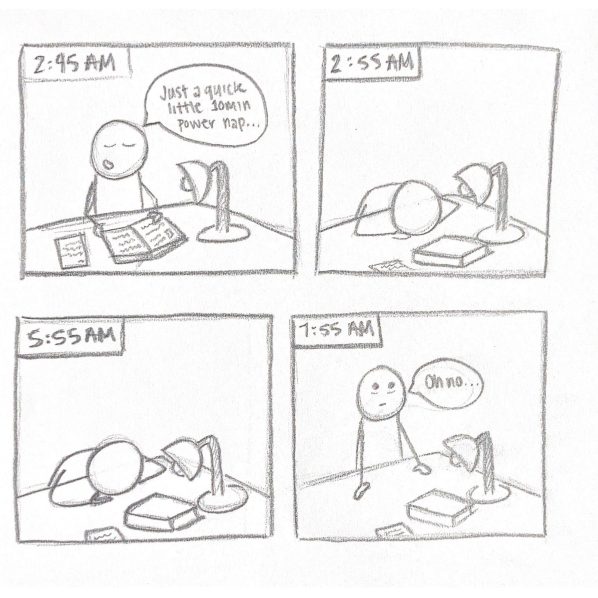
This comic is inspired by my high school life. I always set a time and tried to start studying at that time. However, it often failed because I could not check the time while texting my friend or watching YouTube videos. In college, I just shift my day and night, since I prefer studying at night and dawn. However, it was hard in high school, so sleep was my enemy. Crafting quadriptych was fun. Brainstorming ideas was not easy, so I kept drawing and erasing for a few times. Just like a triptych, it was hard to put a story in limited numbers of panels. However, I felt like a quadriptych is easier than a triptych, since there are more panels that I can utilize. Also, it was pretty hard to express feelings of the character through facial expression, since my drawing is simple, so there was no multiple options that I can draw. I clearly showed time change in the bottom left of each panel, since time is one of the most important features in this comic that shows the beginning, middle, and end.

Literacy Narrative Comic Reflection

This step in the literacy narrative project process has by far been my favorite. It definitely took me the longest to finish but working to put it together the way I wanted was well worth it. I took great inspiration from the works we’ve read so far to guide my moment, image, flow, etc. It was difficult to summarize and transform my alphabetic literacy narrative into a comic. I struggled when choosing which moments to use and how to jump through time. I settled on having the first page with the most panels dedicated to the main memory in my narrative, my dad reading me stories. I attempted to use the full page to show a hidden music note created across the panels. It was relatively successful, and I am happy with how the majority of my comic turned out.

I drew my first draft on loose leaf paper as a very, very rough sketch. After seeing how Small, and Walden go through time with their images, I realized I could convey a large amount of my literacy narrative in each page without needing the comic to be pages and pages long. A part of thinking about my narrative in terms of images made more sense in my head because that is how I see these memories, as images. My analytical process was not much different from writing the essay. I decided to use words to reveal my analysis on the last page. I struggled to think of a way to convey the message using more images, however, I think it makes the most sense this way.  

My second page speeds through time to get to my second important memory, senior year Frankenstein project. This is similar to my essay narrative because I followed the story very closely. The main difference in crafting the comic was that I was able to depict these moments as if they were happening in the present. My third page includes the moment I realized I could tailor reading and writing to something I enjoyed. I slowed down time in the first four panels to emphasize this turning point in my life. I tried to have the two panels of just my head up close show the wheels turning when my teacher says I can choose how to present the project. I have myself look up from writing to show she caught my attention. I then switch back to a line or narration and finish the page with a panel from my point of view, like the first panel of the page. I tried to vary the frame and image many times throughout the comic. It was difficult not to have every image look similar, so I did some revising.

This project has gone through multiple steps of drafting and revision which helped me immensely. Starting with the literacy narrative workshop allowed me to get ideas down without even thinking about writing the story. Then, after having the essay done, drafting the comic was crucial because I had to move and change panels/pages to improve flow and include the creative elements of comics. If I had more time and resources, I would definitely make my handwritten text neater and more uniform, such as putting boxes around all the narration like the second page. Otherwise, I think the whole process allowed me to produce my comic successfully.

Spooky Money

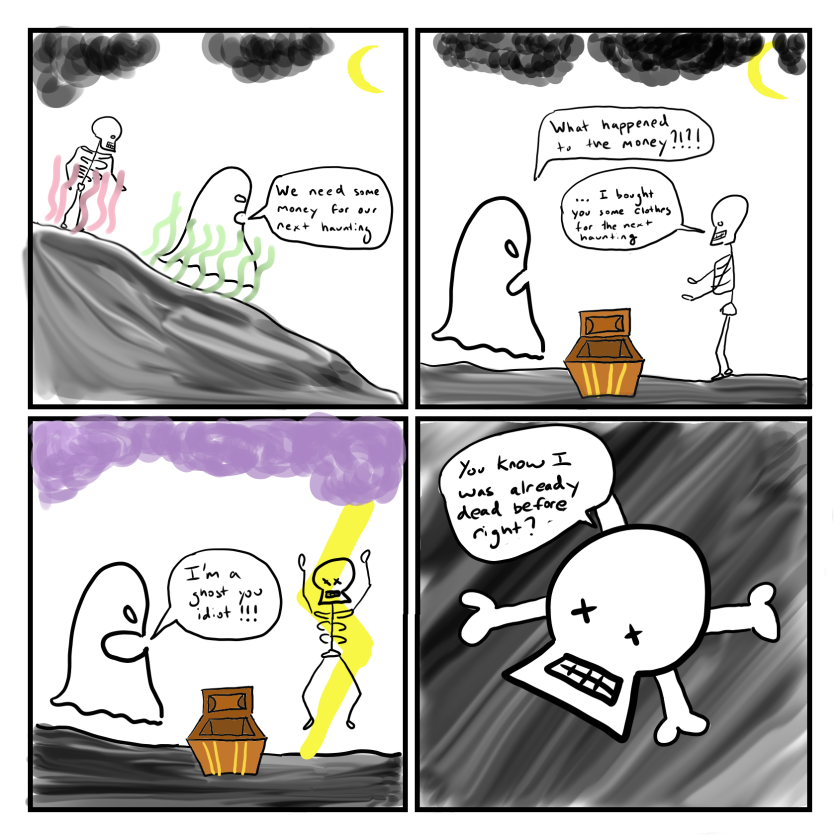
For the quadriptych I decided to make it using the same characters from my triptych. I wanted to see how the same or similar ideas would change from a triptych to a quadriptych. This piece is self-standing, but you can get some more interesting ideas if you read both this piece and the triptych. If you read this piece alone you might think that these two already know one another, but the triptych reveals that the ghost recruited the skeleton. Also, in the triptych it was unclear if the ghost could control lightning, but it looks like he can in this piece.

What was difficult about composing this piece was finding the right plot of events that would fit into the four panel style. I found it actually more difficult to compose the quadriptych than the triptych because you need a middle conflict that can be broken down into two essential panels. Each panel needed to be important such that when you remove one panel, it makes the story unclear. Creating the two conflict panels was difficult, but reading it as an audience, to me, felt more satisfying than reading the triptych because of that prolonged tension. The final panel is more lighthearted, giving a resolution to that tension which makes it satisfying to the reader. The beginning and ending panels still feel similar to the triptych because only one panel represented the beginning and the end. I think it would be interesting to see how to prolong the beginning/ending panels and what effect that has on me drawing it and me reading it.

Power Nap

Four-panel comic drawn by Me

Throughout high school I would often sleep very late, staying up to finish homework and projects—sometimes pulling all-nighters. However, there was times in which I’d get really sleepy but still had something to finish so I would take quick 10 to 15-minute power naps at my desk to recharge then continue working. Unfortunately, those power naps were not always succesfully carried out. I would sleep the remainder of the night and realize it until it was time to get up and ready for school—my assignment also incomplete.

Crafting this quadriptych comic was a very fun process. At first, the idea of adding one more panel in comparison to our triptych was relieving since I struggled a bit with deciding what parts of the narrative should be presented, but at the same time now it was “I gotta think of more content to present visually from the narrative”. For inspiration, I went through some of my favorite webtoon comic Safely Endangered since the author often uses these triptych and quadriptych formats. The Safely Endangered comics are very simple and really funny; since a lot of them are based on “common” happenings, such as applying eye drops or waking up still tired, I decided to think about my personal common happenings. I sketched out two different possible panel compositions. The first two panels in my first sketch included a longer version of the dialogue in my final sketch, followed by only 1 panel of sleeping before the waking up panel. The second sketch was basically the draft of my final version: one panel with short dialogue at the beginning, followed by two panels of sleeping before waking up. I went ahead and chose the second composition because having those middle two panels stretch out helps emphasize the passage of time—which plays along ironically with my “power naps”. Compared to the triptych sketch, this felt similar in having to figure out what was most appropriate way to efficiently present my narrative. However this quadriptych was different not only since I drew it rather than base it off one photo, but also it felt like I could present a longer and more detailed narrative even though it’s only a one panel difference.

css.php