The Secret Language of Comics

Tracing Pages Reflection

The Tracing Pages assignment was something that I’ve never done before. I thought that the process of first tracing, then annotating and then finally writing the essay was very conductive to the inductive style of writing. Normally I try to start from the claim or thesis, but the tracing and the annotating made me notice patterns, which allowed me to make a claim. The challenge was actually choosing which patterns to include because 500-750 words is limited space.

It was almost like building from the ground up, which mimics the style of the essay. Even though this was new, I have done something similar to inductive writing, but we did not have the last section where we synthesized what we talked about. The synthesis was definitely the hardest part to put together because it was completely new and it was almost like backwards thinking. What really helped me through this was to write and then come back to it some other time to see if the ideas in the synthesis were coherent.

Overall I think that this essay assignment helped me better understand the Secret Language of comics. Language is built from small units and writing or thinking inductively throughout this assignment helped me uncover those small units and piece them together into a message. You can read this essay where I make the claim that both Spinning and Stitches use dualities in time and color to create a relationship with the audience. You’ll see how the two things create a message within the story and how they combine to serve an audience.

Tracing Pages Reflection

The Thesis of my essay is that In Spinning and Stitches, the authors present different ways to confront trauma and control the passing of time to emphasize pivotal moments and feelings in the story. The stopping of time during the comic’s traumatizing event allows the reader to control the pace at which they read to give them the time to deal with the emotions presented.

The process of annotating the pages was a beneficial way of getting my thoughts flowing. But I found it challenging to explain some of the things that I saw on the page. When I started, I knew which page I wanted to trace for Stitches, but choosing one specific page for Spinning was a little more difficult because the page I decided required me to sum up a lot of emotionally weighted information. The tracing process helped me solidify a specific topic that I wanted to discuss in my essay and made the similarities between the two texts more explicit.

Writing an inductive essay for the first time was a disorienting experience. I found it challenging to organize my thoughts and arguments in a way that flowed together coherently. Before writing my essay, I created an outline of the ideas I wanted to make and the evidence I wanted to use when explaining, but I felt a little lost in the process of writing. My thought process toward writing a paper had to be revised to get my argument across.

Through the tracing pages assignment, I learned a lot more about comics’ secret language because I was able to focus more on individual pages and the tools that helped aid in the progression of the narrative. Also, this assignment allowed me to understand the commentary on the trauma that David Smalls and Tillie Walden present in their comics.

Tracing Assignment + Essay

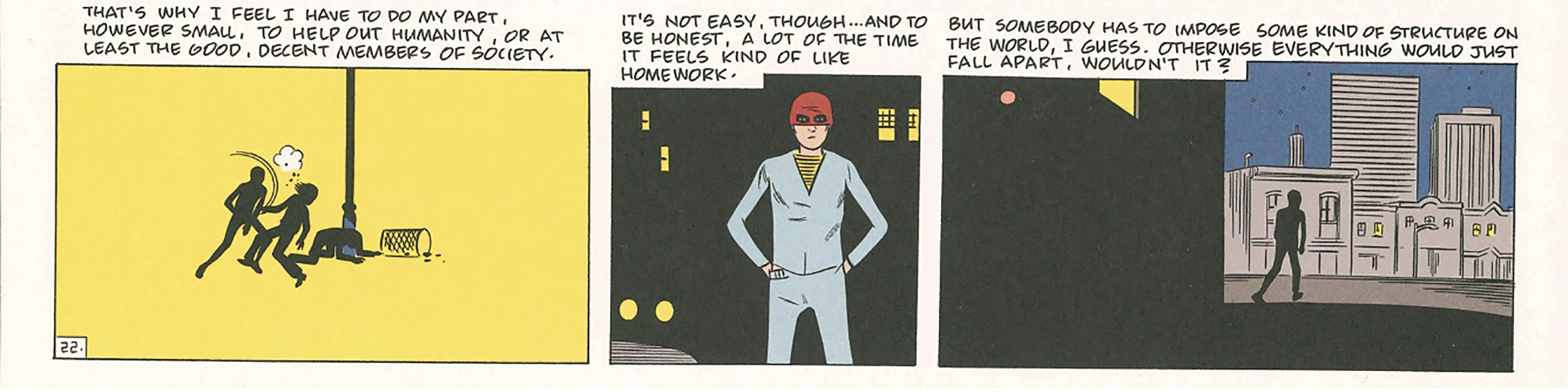
Image credit: Smalls,David. “Stitches” pg. 234

Reflection of Tracing Stitches and Spinning

Choosing one page from the entire book was not easy. I traced three different pages for Spinning, since I felt like I was forcing to fit the essay into the image when I wrote based on what I traced. As I attempted to come up with the thesis, I was struggling to find some similarities and differences between Stitches and Spinning. However, after I chose proper pages for my analysis, the process of tracing Stitches and Spinning allowed me to see some features that I did not see when I just read them, such as shading, the arrangement of panels, perspectives, and backgrounds. Therefore, tracing helped me brainstorming ideas about my analysis essay. By annotating the traced images, I could find some rhetorical strategies and visual patterns of two comics. 

Inductive writing was somewhat difficult for me, since I was used to deductive writing. I felt like my induction does not provide any more analysis or new information about my thesis. Writing the final section was harder than the first two sections, because I felt like I was repeating what I’ve said earlier in the essay. It was hard to come up with a larger claim that explains how the observations and patterns that I analyzed in previous sections really mean in the books. These challenges made me read what I wrote over and over again, to be not repetitive and be more analytical. Through this assignment, I could better understand and empathize with the stories of Stitches and Spinning. Tracing, annotating, and analyzing each page of these two books helped me identify the “secret language of comics.” Also, I could notice more about the perspectives of the characters that authors want to display in the book.

Analyzing Their Tears

Assignment Prompt

Trauma Exposure: That’s “Why Comics”

Annotating the traced pages was very different from annotating and analyzing a novel. I was especially thrown off because we had to keep the text out of the page and focus on the stylistic elements of the page. It was useful for me to look for the aspects of comics that stood out the most in both books, knowing I would be comparing them. Once I noticed a pattern or two, the annotating started to flow much more.

Putting my thesis at the end of my essay made me really focus on the topic sentences and analysis within each section. I was building my claim as I wrote the essay which allowed me to develop the idea throughout the writing process.

I definitely thought a close reading of these pages broadened my understanding of Stitches and Spinning. Focusing in on specific aspects such as frame, image, and moment for each page allowed me to apply the analysis to the rest of the book because of the relatively similar style carried throughout each book. Now knowing how deliberate every aspect of the comic is, I have a better understanding of each author truly putting the reader into their mind and position.

Tracing Pages Reflection


Assignment link here.
Essay link here


Reflection timeeeeee

Thesis: In “Stitches” and “Spinning,” the different uses of gutters and perspectives support each other to show the character development of the main character in the frame while they are in the presence of another character. Both authors use the same technique but in different ways to portray their narratives.

While tracing the panels, I was mainly thinking about art style, and how they drew the panels. I enjoyed doing it because I felt productive but not at the same time. After tracing the pages, I couldn’t find things that I could analyze, but I went back to the chart with all the elements of a comic. Looking at each column, I was able to find at least one thing to annotate or note. I really just had to not overthink it and just *look*. It was fun realizing similarities and differences in between the two pages.

As for the essay style, I was looking forward to writing it. When I write the usual 5 paragraph deductive essays, I find a better way to present the essay near the end after I discussed the thesis. When I write an essay, I have a good grasp about the parts but not how they connect as a whole. Inductive writing would make sense for me because I can really present the main part of the essay after I discuss the evidence. I would need to compare deductive and inductive essays to truly see which one I like better. I also had to limit myself to not reveal the thesis in the early sections because you usually had to connect it back to the thesis while writing about the evidence.

As for the secret language of comics, I think it helps me to watch out for certain elements of the comic and bring it into a boarder context of the story. I only annotated one page per comic, but if I spent time in analyzing more pages, I would be able to get a better grasp of the comics. I learned that I had to compare frames to see certain things like with “Spinning” I didn’t realize the changed background in between panels. I totally overlooked it at first.

Tracing Stitches and Spinning Reflection

The thesis of my paper is that both Tillie Walden and David Small both slow down time and disorient the intended direction of reading to emphasize their respective emotional climaxes. I identified each of these climaxes as David realizing that his mother doesn’t love him, and Tillie underperforming at worlds, which eventually leads to her crashing her car.

Before choosing a page from both Spinning and Stitches, I knew that I wanted the pages to relate somehow. Something that we talked in class about both works was Tillie’s and David’s emotional climaxes. Therefore, I took a page from each comic that I interpreted as each character’s emotional climax. I felt that annotating and tracing the pages was very useful. It was almost like a forced pre-writing assignment since it helped me brainstorm ideas. By analyzing and annotating my tracings, I applied the concepts in Chute’s essays and began to notice the similarities and differences between the works.

The writing of this essay did not change my writing process too much. I still brainstormed ideas before and lightly outlined my essay. If anything, this essay was quicker to write because it is acceptable to immediately to start analyzing the evidence. There is no need to write and wordsmith an introduction.

After doing this assignment, I do feel that I understand “the secret language of comics” better. When initially reading both of these works, I did not notice any of the patterns I discussed in my essay. During my first read of both Stitches and Spinning, I was more reading for plot rather than examining the author’s images intricacies. Tracing and annotating really opened my eyes to how each author poetically elaborated about key plot elements. For instance, by tracing the page in Stitches, I realized that all the panels showed no signs of life, which emphasizes David’s loneliness. In my essay, I make further analysis like this. Therefore, I feel like I do understand Stitches and Spinning more after writing this essay. By tracing and annotating, I know realize why creating a certain page or panel may take weeks for an author to illustrate. In Chute’s essay, Art Spegielman says that he sometimes spends weeks on certain panels in pages. I initially thought that he did to make his art high quality and implement simple illusions. However, after writing this essay, I know realize that authors must draw their images at a high quality, but also they must decide, which poetic patterns they will use to highlight certain messages or plot points.

Prompt

Essay

Tracing Pages Reflection

The thesis of my essay is “The two different uses of slowed progression of time and movement were used to highlight the significance of both scenes.”. My main arguments are that the choice of moment and flow were most influential on the pages I analyzed. The design choices made these pages stand out among others throughout the novels.

I enjoyed the process of tracing and annotating. It was interesting to analyze the pages without text, even though the pages I chose originally didn’t have much dialogue or text. It was useful to go through the five choices in comic making and see if I could see them represented on the page. The suggested themes to consider were also helpful because they helped me categorize my annotations. The whole process helped me delve deeper than surface level observations.

My writing process didn’t completely change with the inductive thinking format. I knew pretty quickly what my first two topic sentences would be. It has always been hard for me to formulate thesis sentences. In this instance, I found it to be more difficult because I would easily slip into thinking that my first topic was my thesis even though it wasn’t. This confused me until I took some time to draw conclusions I made from the points made in the first couple of paragraphs. I was then able to choose which I felt fit the best.

As mentioned before, this project helped me look deeper at the pages. I think I overlooked some concepts when I first read these two novels. Analyzing them allowed me to look really close and try to observe as much as possible. It is easy for me to gloss over pages and not look at deeper meanings. After this process, I realized why that can be dangerous. It can cause me to miss important themes and messages that could possibly change my viewpoint on a character, situation, or topic. For example, I honestly missed the point of the zoomed-in panels in Stitches and the many little panels on the page in Spinning. I have been able to understand the likely motivations behind these design choices. I think I now appreciate the creativity and attention to detail a lot more.

Link to project: https://selazzioui.wordpress.com/tracing-pages/

Link to assignment prompt: https://eng181s21.davidmorgen.org/assignments/tracing-pages/

Tracing Stitches and Spinning Reflection

The thesis of my essay is: having similar flow while describing similar experiences with their crushes, the authors are able to help their readers relate to the comics through their own imagination. Because both authors used similar techniques describing their similar experiences, their comic help the readers relate to the content in a similar way. The readers will either relate to the story through their own experience, or their imagination.

Before writing my essay, I traced the pages of Stitches and Spinning, and annotated them with my own notes. This process helped me understand the panels better since I was essentially the author drawing the comics. I noticed more details about the panels, such as the length of the descriptions and that the panels do not follow an order for the readers to read, which I included in my annotations. Looking at the whole page, I felt like I understood the comic better, and also understood some of the techniques that the authors used to help the readers relate to their comic. This helped the writing process of my essay.

To address the assignment of writing an inductive essay, I did not change my writing process drastically. I was never truly conformed to writing one specific structure of essay, especially during my high school years. My high school teachers never taught me that the five-paragraph essay is the only way to write essays, instead they assigned me similar essays to this inductive essay, and sometimes even allowed me to create my own structure. Therefore, I did not feel clueless when I was assigned an inductive essay. I just learned the structure of the inductive essay and went on with it.

Overall, I think this assignment helped me understand the “secret language of comics” better. I noticed more details in the comics that a normal reader would sometimes glance over, and realized that some of those details are not random but techniques that the author used to help the readers understand and relate to the content. One insight about the two books that I did not notice before it how similar they are. The main characters in the books, who are the authors in reality, describe multiple stories that are very similar to each other in almost the same way. The two pages that I have selected for my essay is only one example, but after trying to find 2 pages from each book, I noticed a significant amount of similarities between the books.

Assignment prompt

Analysis essay

Sketch 6: What’s in your bag?

Contents: A calculator, Macbook Pro, 2 black pens, spiral notebook, computer charger, and a USB-C Iphone charger.

I think this image partially represents me. Currently, I do not have any in person classes and majority of my work is online. I do not need to carry around notebooks or papers for each class because my notes, submissions and readings are all accessible from my computer. At a glance, I would assume this is a minimalist backpack with only essentials. As I grew up, my backpack was always filled with books and was very heavy. I try to pack as lightly as possible now so my backpack does not become a hassle when I am going from place to place. My brother received the backpack from one of his past jobs and gave it to me.

Sunday Sketch 6 – What’s in your bag?

  • Tory Burch Women’s Piper Small Zip Backpack: I bought this backpack just because it was pretty, but now I am regretting it, because it does not have enough storage space.
  • iPad Air & Apple Pencil: I use my iPad instead of notebooks. The notes for every class I take are in my iPad.
  • MacBook Air & Kate Spade Laptop Sleeve: I bought this MacBook in my junior year of high school and it is the most important thing when I study since high school. The laptop sleeve protects my laptop from minor knocks and bumps.
  • Hair Ties: I tie my hair when I study or eat, so I always need to have it with me.
  • Bath & Body Works Hand Sanitizer: To sanitize my hand when I am outside.
  • Tearin Free Eye Drops: When my eyes are dry.
  • Pencil case: I put pencils, pens, highlighters, white-out, and eraser in my pencil case, so I can use them when I need to write something. 
  • AirPods 2 & AirPods Pro: AirPods is needed when I want to listen to music or watch videos. I bring two of them, since I often forget to charge those.
  • Jo Malone Wild Bluebell Perfume: I just love perfume.
  • Casio Scientific Calculator: For my Chemistry class.
  • Sticky Notes: I often forgot what to do, so I write it down on sticky notes and put them on my laptop or the wall.

I feel like this image is very representative of me, because I do not carry anything unnecessary and always want to keep my backpack as light as I can. I tried to organize things in a square shape to make them look neater. I feel like this was the easiest Sunday Sketch that I had, since I only needed to explain what are in my backpack. Representing myself in a catalog of the stuff in my bag is a type of writing, since it reflects who I am as a person.

css.php